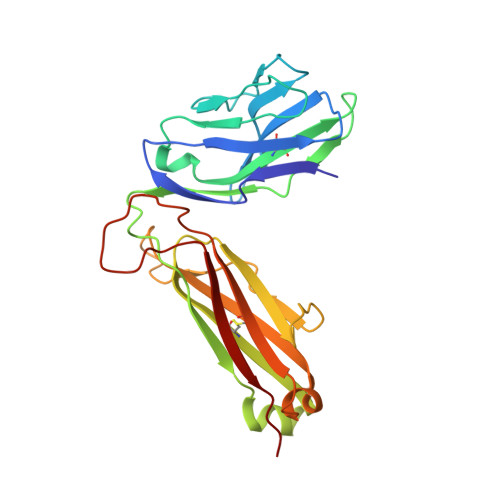
4MNQ | pdb_00004mnq

TCR-peptide specificity overrides affinity enhancing TCR-MHC interactions


Experimental Data Snapshot

  • Method: X-RAY DIFFRACTION
  • Resolution: 2.74 Å
  • R-Value Free: 
    0.284 (Depositor), 0.286 (DCC) 
  • R-Value Work: 
    0.214 (Depositor), 0.217 (DCC) 
  • R-Value Observed: 
    0.218 (Depositor) 

wwPDB Validation 3D Report Full Report

Validation slider image for 4MNQ

This is version 1.4 of the entry. See complete history

Literature

T-cell receptor (TCR)-peptide specificity overrides affinity-enhancing TCR-major histocompatibility complex interactions.

Cole, D.K.Miles, K.M.Madura, F.Holland, C.J.Schauenburg, A.J.Godkin, A.J.Bulek, A.M.Fuller, A.Akpovwa, H.J.Pymm, P.G.Liddy, N.Sami, M.Li, Y.Rizkallah, P.J.Jakobsen, B.K.Sewell, A.K.

(2014) J Biological Chem 289: 628-638

  • DOI: https://doi.org/10.1074/jbc.M113.522110
  • Primary Citation Related Structures: 
    4MNQ

  • PubMed Abstract: 

    αβ T-cell receptors (TCRs) engage antigens using complementarity-determining region (CDR) loops that are either germ line-encoded (CDR1 and CDR2) or somatically rearranged (CDR3). TCR ligands compose a presentation platform (major histocompatibility complex (MHC)) and a variable antigenic component consisting of a short "foreign" peptide. The sequence of events when the TCR engages its peptide-MHC (pMHC) ligand remains unclear. Some studies suggest that the germ line elements of the TCR engage the MHC prior to peptide scanning, but this order of binding is difficult to reconcile with some TCR-pMHC structures. Here, we used TCRs that exhibited enhanced pMHC binding as a result of mutations in either CDR2 and/or CDR3 loops, that bound to the MHC or peptide, respectively, to dissect the roles of these loops in stabilizing TCR-pMHC interactions. Our data show that TCR-peptide interactions play a strongly dominant energetic role providing a binding mode that is both temporally and energetically complementary with a system requiring positive selection by self-pMHC in the thymus and rapid recognition of non-self-pMHC in the periphery.


  • Organizational Affiliation
    • From Cardiff University School of Medicine, Heath Park, Cardiff CF14 4XN.

Macromolecule Content 

  • Total Structure Weight: 94.57 kDa 
  • Atom Count: 6,684 
  • Modeled Residue Count: 825 
  • Deposited Residue Count: 825 
  • Unique protein chains: 5

Macromolecules

Find similar proteins by:|  3D Structure
Entity ID: 1
MoleculeChains  Sequence LengthOrganismDetailsImage
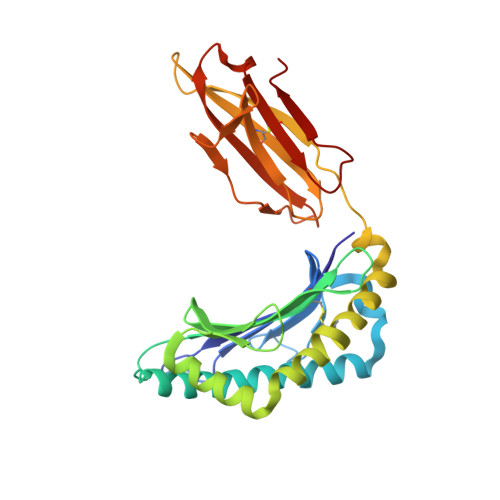
HLA class I histocompatibility antigen, A-2 alpha chain276Homo sapiensMutation(s): 0 
Gene Names: HLA-AHLAA
UniProt & NIH Common Fund Data Resources
Find proteins for P04439 (Homo sapiens)
Explore P04439 
Go to UniProtKB:  P04439
PHAROS:  P04439
GTEx:  ENSG00000206503 
Entity Groups
Sequence Clusters30% Identity50% Identity70% Identity90% Identity95% Identity100% Identity
UniProt GroupP04439
Sequence Annotations
Expand
Reference Sequence
Find similar proteins by:|  3D Structure
Entity ID: 2
MoleculeChains  Sequence LengthOrganismDetailsImage
Beta-2-microglobulin100Homo sapiensMutation(s): 0 
Gene Names: B2MCDABP0092HDCMA22P
UniProt & NIH Common Fund Data Resources
Find proteins for P61769 (Homo sapiens)
Explore P61769 
Go to UniProtKB:  P61769
PHAROS:  P61769
GTEx:  ENSG00000166710 
Entity Groups
Sequence Clusters30% Identity50% Identity70% Identity90% Identity95% Identity100% Identity
UniProt GroupP61769
Sequence Annotations
Expand
Reference Sequence
Find similar proteins by:  Sequence   |   3D Structure  
Entity ID: 3
MoleculeChains  Sequence LengthOrganismDetailsImage
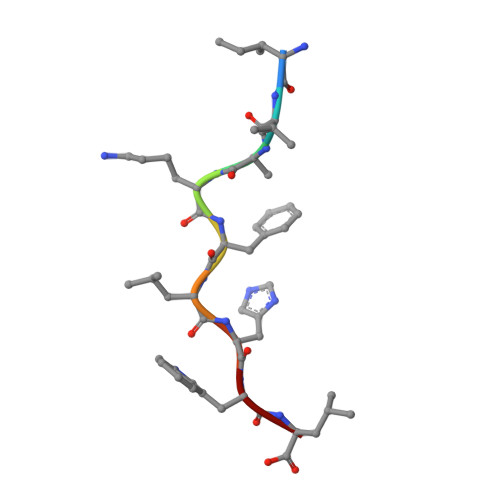
Telomerase reverse transcriptase9Homo sapiensMutation(s): 0 
EC: 2.7.7.49
UniProt & NIH Common Fund Data Resources
Find proteins for O14746 (Homo sapiens)
Explore O14746 
Go to UniProtKB:  O14746
PHAROS:  O14746
GTEx:  ENSG00000164362 
Entity Groups
UniProt GroupO14746
Sequence Annotations
Expand
Reference Sequence
Find similar proteins by:|  3D Structure
Entity ID: 4
MoleculeChains  Sequence LengthOrganismDetailsImage
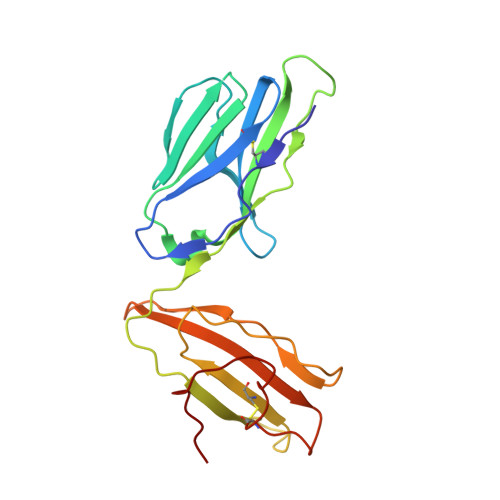
Uncharacterized protein, T-cell receptor, sp3.4 alpha chain200Pan troglodytesHomo sapiens
This entity is chimeric
Mutation(s): 0 
Gene Names: LOC452776
UniProt
Find proteins for H2RG00 (Pan troglodytes)
Explore H2RG00 
Go to UniProtKB:  H2RG00
Find proteins for K7N5N2 (Homo sapiens)
Explore K7N5N2 
Go to UniProtKB:  K7N5N2
Entity Groups
Sequence Clusters30% Identity50% Identity70% Identity90% Identity95% Identity100% Identity
UniProt GroupsK7N5N2H2RG00
Sequence Annotations
Expand
Reference Sequence
Find similar proteins by:|  3D Structure
Entity ID: 5
MoleculeChains  Sequence LengthOrganismDetailsImage
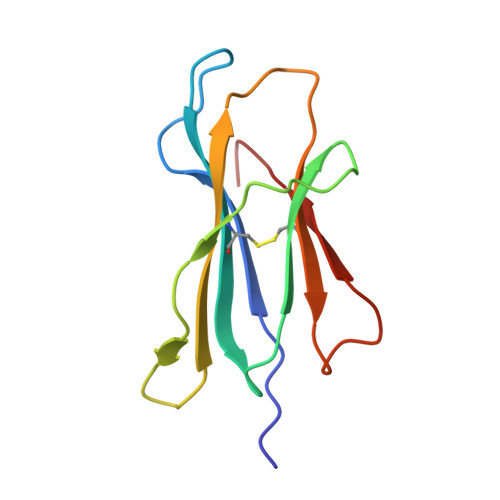
V_segment translation product, T-cell receptor beta-1 chain C region240Homo sapiensMutation(s): 0 
Gene Names: TCRBV13S1TRBC1
UniProt
Find proteins for P01850 (Homo sapiens)
Explore P01850 
Go to UniProtKB:  P01850
Entity Groups
Sequence Clusters30% Identity50% Identity70% Identity90% Identity95% Identity100% Identity
UniProt GroupP01850
Sequence Annotations
Expand
Reference Sequence

Experimental Data & Validation

Experimental Data

  • Method: X-RAY DIFFRACTION
  • Resolution: 2.74 Å
  • R-Value Free:  0.284 (Depositor), 0.286 (DCC) 
  • R-Value Work:  0.214 (Depositor), 0.217 (DCC) 
  • R-Value Observed: 0.218 (Depositor) 
Space Group: P 1 21 1
Unit Cell:
Length ( Å )Angle ( ˚ )
a = 94.22α = 90
b = 48.49β = 107.86
c = 118.07γ = 90
Software Package:
Software NamePurpose
Aimlessdata scaling
PHASERphasing
REFMACrefinement
PDB_EXTRACTdata extraction
XSCALEdata scaling

Structure Validation

View Full Validation Report


Entry History 

Deposition Data

Revision History  (Full details and data files)

  • Version 1.0: 2013-11-13
    Type: Initial release
  • Version 1.1: 2013-12-04
    Changes: Database references
  • Version 1.2: 2014-05-14
    Changes: Database references
  • Version 1.3: 2017-08-02
    Changes: Refinement description, Source and taxonomy
  • Version 1.4: 2024-10-16
    Changes: Data collection, Database references, Derived calculations, Structure summary