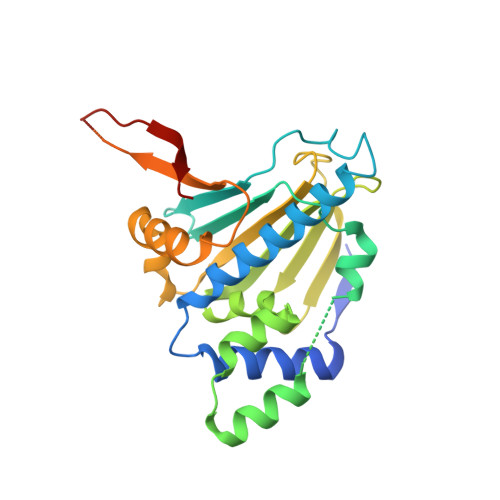
4NH9 | pdb_00004nh9

Correlation between chemotype-dependent binding conformations of HSP90 alpha/beta and isoform selectivity


Experimental Data Snapshot

  • Method: X-RAY DIFFRACTION
  • Resolution: 2.77 Å
  • R-Value Free: 
    0.277 (Depositor), 0.286 (DCC) 
  • R-Value Work: 
    0.245 (Depositor), 0.261 (DCC) 
  • R-Value Observed: 
    0.248 (Depositor) 

wwPDB Validation 3D Report Full Report

Validation slider image for 4NH9

Ligand Structure Quality Assessment 


This is version 1.1 of the entry. See complete history

Literature

Correlation between chemotype-dependent binding conformations of HSP90 alpha / beta and isoform selectivity-Implications for the structure-based design of HSP90 alpha / beta selective inhibitors for treating neurodegenerative diseases.

Ernst, J.T.Liu, M.Zuccola, H.Neubert, T.Beaumont, K.Turnbull, A.Kallel, A.Vought, B.Stamos, D.

(2014) Bioorg Med Chem Lett 24: 204-208

  • DOI: https://doi.org/10.1016/j.bmcl.2013.11.036
  • Primary Citation Related Structures: 
    4NH7, 4NH8, 4NH9

  • PubMed Abstract: 

    HSP90 continues to be a target of interest for neurodegeneration indications. Selective knockdown of the HSP90 cytosolic isoforms α and β is sufficient to reduce mutant huntingtin protein levels in vitro. Chemotype-dependent binding conformations of HSP90α/β appear to strongly influence isoform selectivity. The rational design of HSP90α/β inhibitors selective versus the mitochondrial (TRAP1) and endoplasmic reticulum (GRP94) isoforms offers a potential mitigating strategy for mechanism-based toxicities. Better tolerated HSP90 inhibitors would be attractive for targeting chronic neurodegenerative diseases such as Huntington's disease.


  • Organizational Affiliation
    • Vertex Pharmaceuticals, Department of Chemistry and Drug Innovation, 11010 Torreyana Road, San Diego, CA 92121, United States. Electronic address: Justin_Ernst@vrtx.com.

Macromolecule Content 

  • Total Structure Weight: 31.49 kDa 
  • Atom Count: 1,704 
  • Modeled Residue Count: 214 
  • Deposited Residue Count: 273 
  • Unique protein chains: 1

Macromolecules

Find similar proteins by:|  3D Structure
Entity ID: 1
MoleculeChains  Sequence LengthOrganismDetailsImage
Endoplasmin273Homo sapiensMutation(s): 0 
Gene Names: HSP90B1GRP94TRA1
EC: 3.6.4
UniProt & NIH Common Fund Data Resources
Find proteins for P14625 (Homo sapiens)
Explore P14625 
Go to UniProtKB:  P14625
PHAROS:  P14625
GTEx:  ENSG00000166598 
Entity Groups
Sequence Clusters30% Identity50% Identity70% Identity90% Identity95% Identity100% Identity
UniProt GroupP14625
Sequence Annotations
Expand
Reference Sequence

Small Molecules

Ligands 1 Unique
IDChains Name / Formula / InChI Key2D Diagram3D Interactions
2LC

Query on 2LC


Download:Ideal Coordinates CCD File
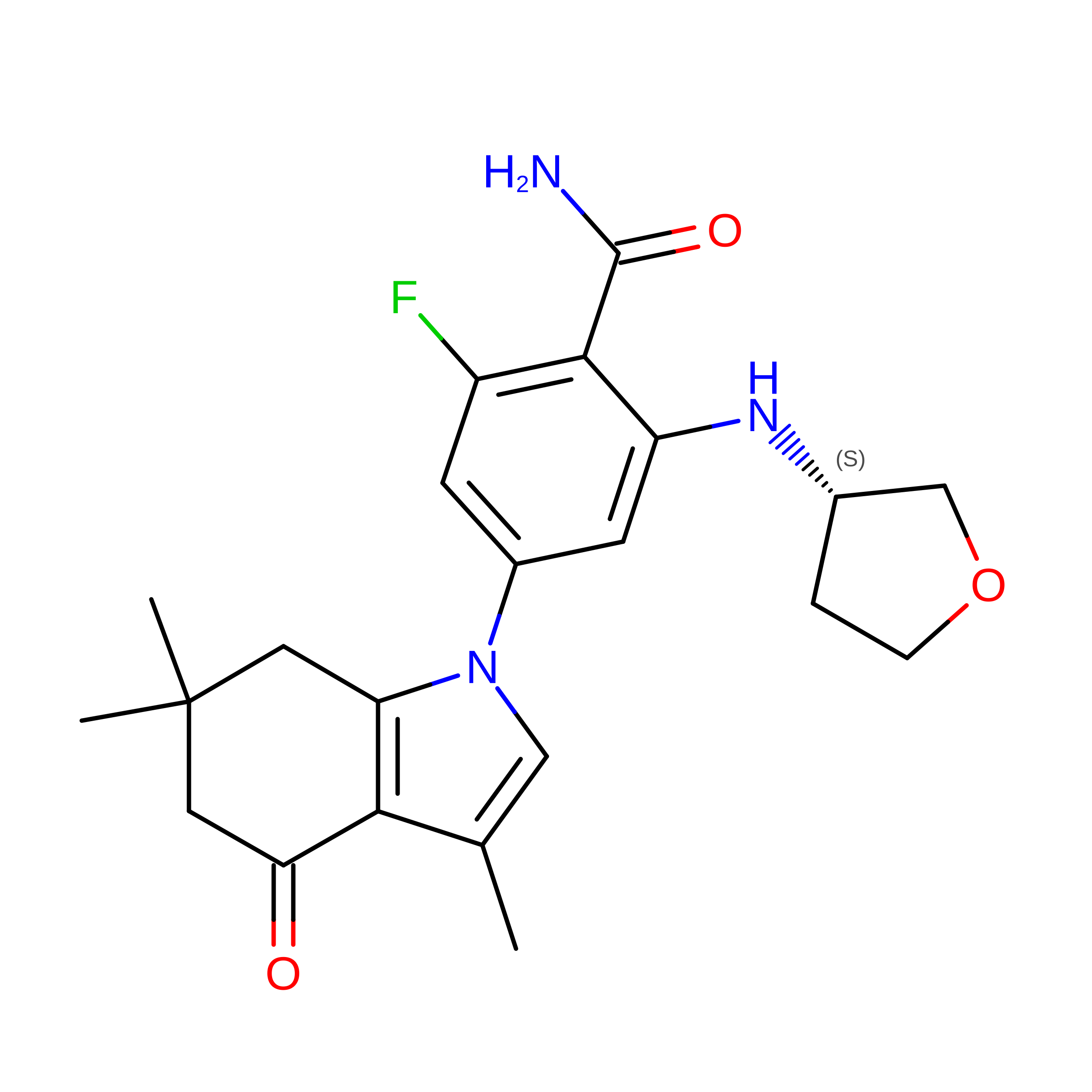
B [auth A]2-fluoro-6-[(3S)-tetrahydrofuran-3-ylamino]-4-(3,6,6-trimethyl-4-oxo-4,5,6,7-tetrahydro-1H-indol-1-yl)benzamide
C22 H26 F N3 O3
GAGDTKJJVCLACJ-ZDUSSCGKSA-N
Binding Affinity Annotations 
IDSourceBinding Affinity
2LC BindingDB:  4NH9 Ki: 375 (nM) from 1 assay(s)

Experimental Data & Validation

Experimental Data

  • Method: X-RAY DIFFRACTION
  • Resolution: 2.77 Å
  • R-Value Free:  0.277 (Depositor), 0.286 (DCC) 
  • R-Value Work:  0.245 (Depositor), 0.261 (DCC) 
  • R-Value Observed: 0.248 (Depositor) 
Space Group: C 2 2 21
Unit Cell:
Length ( Å )Angle ( ˚ )
a = 91.102α = 90
b = 101.194β = 90
c = 63.497γ = 90
Software Package:
Software NamePurpose
BUSTERrefinement

Structure Validation

View Full Validation Report


Ligand Structure Quality Assessment 


Entry History 

Deposition Data

Revision History  (Full details and data files)

  • Version 1.0: 2014-01-22
    Type: Initial release
  • Version 1.1: 2024-02-28
    Changes: Data collection, Database references, Derived calculations