4PNV | pdb_00004pnv

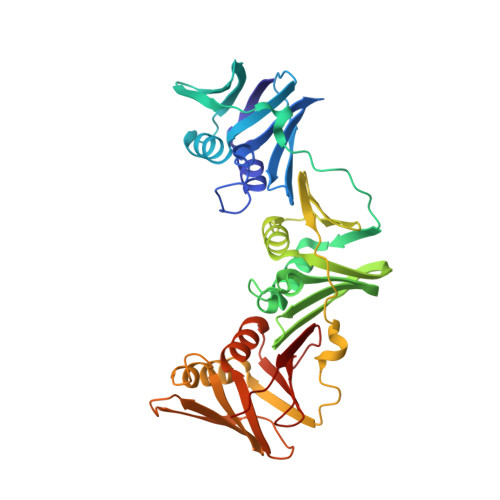
E. coli sliding clamp apo-crystal in P21 space group with larger cell dimensions


Experimental Data Snapshot

  • Method: X-RAY DIFFRACTION
  • Resolution: 1.86 Å
  • R-Value Free: 
    0.234 (Depositor), 0.241 (DCC) 
  • R-Value Work: 
    0.183 (Depositor), 0.190 (DCC) 
  • R-Value Observed: 
    0.185 (Depositor) 

Starting Model: experimental
View more details

wwPDB Validation 3D Report Full Report

Validation slider image for 4PNV

This is version 1.2 of the entry. See complete history

Literature

Bacterial Sliding Clamp Inhibitors that Mimic the Sequential Binding Mechanism of Endogenous Linear Motifs.

Yin, Z.Whittell, L.R.Wang, Y.Jergic, S.Ma, C.Lewis, P.J.Dixon, N.E.Beck, J.L.Kelso, M.J.Oakley, A.J.

(2015) J Med Chem 58: 4693-4702

  • DOI: https://doi.org/10.1021/acs.jmedchem.5b00232
  • Primary Citation Related Structures: 
    4OVF, 4OVG, 4OVH, 4PNU, 4PNV, 4PNW

  • PubMed Abstract: 

    The bacterial DNA replication machinery presents new targets for the development of antibiotics acting via novel mechanisms. One such target is the protein-protein interaction between the DNA sliding clamp and the conserved peptide linear motifs in DNA polymerases. We previously established that binding of linear motifs to the Escherichia coli sliding clamp occurs via a sequential mechanism that involves two subsites (I and II). Here, we report the development of small-molecule inhibitors that mimic this mechanism. The compounds contain tetrahydrocarbazole moieties as "anchors" to occupy subsite I. Functional groups appended at the tetrahydrocarbazole nitrogen bind to a channel gated by the side chain of M362 and lie at the edge of subsite II. One derivative induced the formation of a new binding pocket, termed subsite III, by rearrangement of a loop adjacent to subsite I. Discovery of the extended binding area will guide further inhibitor development.


  • Organizational Affiliation
    • †School of Chemistry and Centre for Medical and Molecular Bioscience, The University of Wollongong and The Illawarra Health and Medical Research Institute, Wollongong, New South Wales 2522, Australia.

Macromolecule Content 

  • Total Structure Weight: 82.04 kDa 
  • Atom Count: 6,743 
  • Modeled Residue Count: 732 
  • Deposited Residue Count: 732 
  • Unique protein chains: 1

Macromolecules

Find similar proteins by:|  3D Structure
Entity ID: 1
MoleculeChains  Sequence LengthOrganismDetailsImage
DNA polymerase III subunit beta
A, B
366Escherichia coli str. K-12 substr. MC4100Mutation(s): 0 
Gene Names: BN896_3391dnaN
EC: 2.7.7.7

Small Molecules

Ligands 3 Unique
IDChains Name / Formula / InChI Key2D Diagram3D Interactions
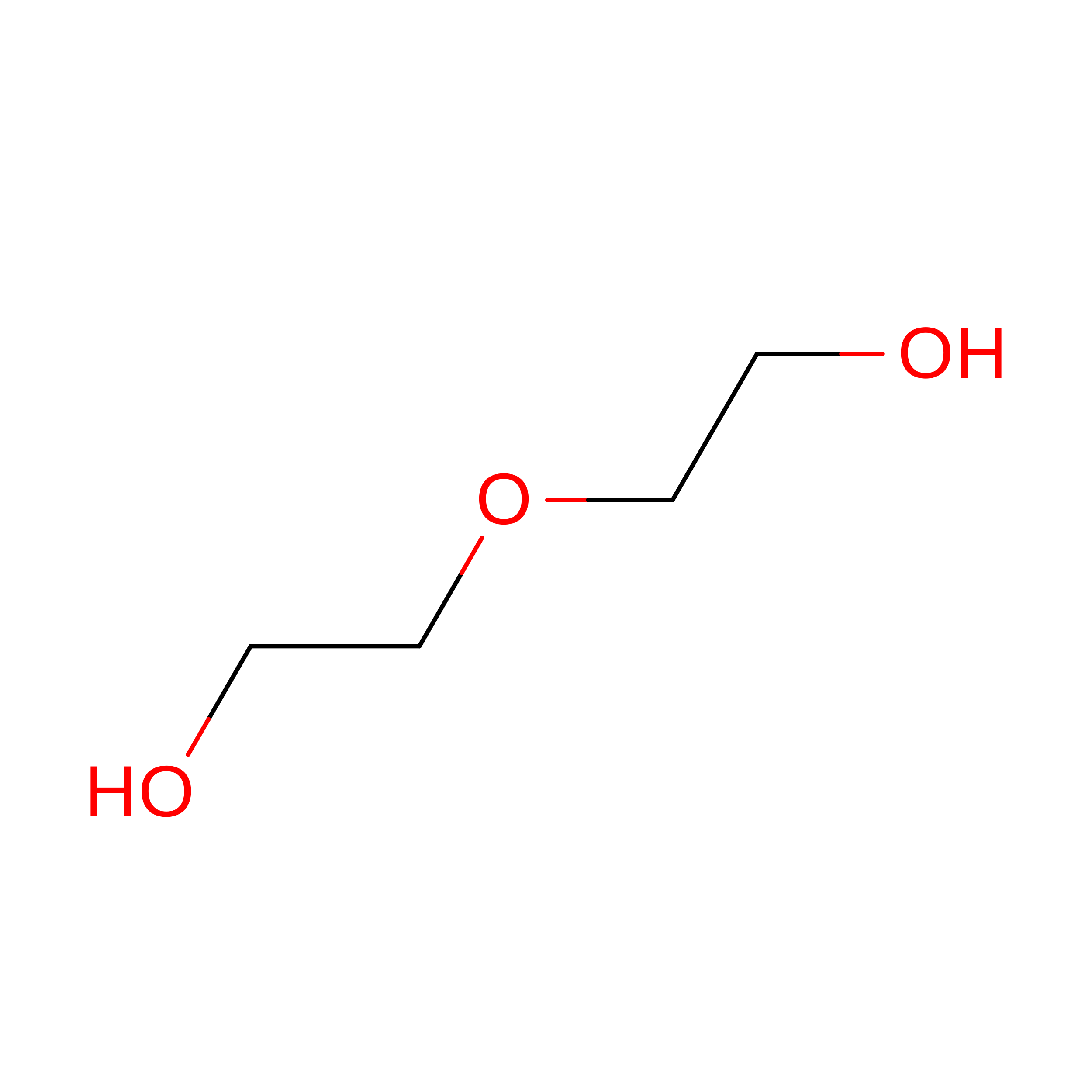
PEG

Query on PEG


Download:Ideal Coordinates CCD File
F [auth A],
K [auth B],
L [auth B]
DI(HYDROXYETHYL)ETHER
C4 H10 O3
MTHSVFCYNBDYFN-UHFFFAOYSA-N
CA

Query on CA


Download:Ideal Coordinates CCD File
C [auth A]
E [auth A]
G [auth A]
H [auth A]
I [auth A]
C [auth A],
E [auth A],
G [auth A],
H [auth A],
I [auth A],
J [auth B],
M [auth B],
N [auth B]
CALCIUM ION
Ca
BHPQYMZQTOCNFJ-UHFFFAOYSA-N
CL

Query on CL


Download:Ideal Coordinates CCD File
D [auth A],
O [auth B],
P [auth B],
Q [auth B]
CHLORIDE ION
Cl
VEXZGXHMUGYJMC-UHFFFAOYSA-M

Experimental Data & Validation

Experimental Data

  • Method: X-RAY DIFFRACTION
  • Resolution: 1.86 Å
  • R-Value Free:  0.234 (Depositor), 0.241 (DCC) 
  • R-Value Work:  0.183 (Depositor), 0.190 (DCC) 
  • R-Value Observed: 0.185 (Depositor) 
Space Group: P 1 21 1
Unit Cell:
Length ( Å )Angle ( ˚ )
a = 80.138α = 90
b = 70.257β = 114.67
c = 84.469γ = 90
Software Package:
Software NamePurpose
SCALEPACKdata scaling
REFMACrefinement
PDB_EXTRACTdata extraction
MAR345dtbdata collection
HKL-2000data reduction
MOLREPphasing

Structure Validation

View Full Validation Report


Entry History 

Deposition Data

Revision History  (Full details and data files)

  • Version 1.0: 2014-03-05
    Type: Initial release
  • Version 1.1: 2015-06-24
    Changes: Database references
  • Version 1.2: 2023-09-20
    Changes: Data collection, Database references, Derived calculations, Refinement description