4QCI | pdb_00004qci

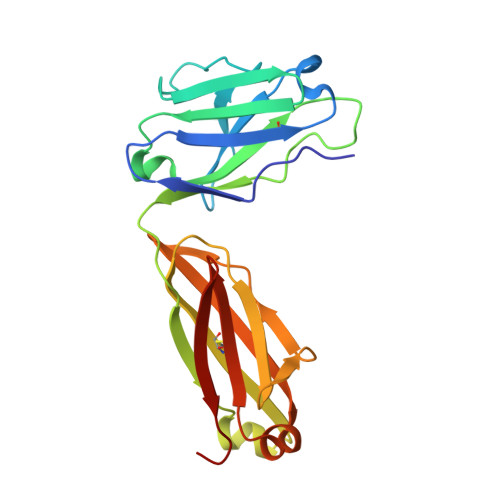
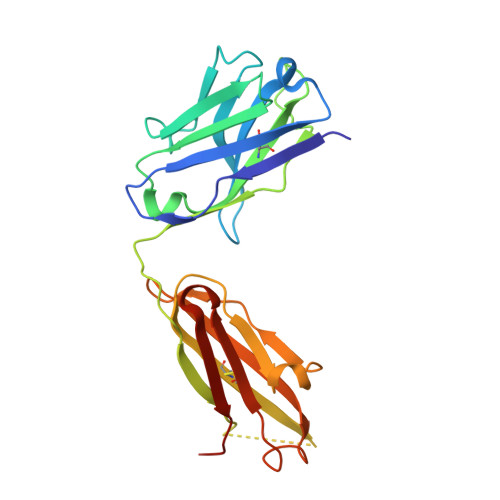
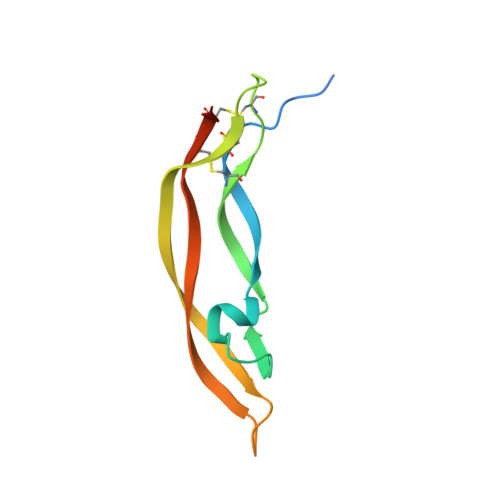
PDGF-B blocking antibody bound to PDGF-BB


Experimental Data Snapshot

  • Method: X-RAY DIFFRACTION
  • Resolution: 2.30 Å
  • R-Value Free: 
    0.247 (Depositor), 0.254 (DCC) 
  • R-Value Work: 
    0.211 (Depositor), 0.224 (DCC) 
  • R-Value Observed: 
    0.213 (Depositor) 

wwPDB Validation 3D Report Full Report

Validation slider image for 4QCI

This is version 1.4 of the entry. See complete history

Literature

Characterization of Binding Mode of Action of a Blocking Anti-Platelet-Derived Growth Factor (PDGF)-B Monoclonal Antibody, MOR8457, Reveals Conformational Flexibility and Avidity Needed for PDGF-BB To Bind PDGF Receptor-beta.

Kuai, J.Mosyak, L.Brooks, J.Cain, M.Carven, G.J.Ogawa, S.Ishino, T.Tam, M.Lavallie, E.R.Yang, Z.Ponsel, D.Rauchenberger, R.Arch, R.Pullen, N.

(2015) Biochemistry 54: 1918-1929

  • DOI: https://doi.org/10.1021/bi5015425
  • Primary Citation Related Structures: 
    4QCI

  • PubMed Abstract: 

    Platelet derived growth factor-BB (PDGF-BB) is an important mitogen and cell survival factor during development. PDGF-BB binds PDGF receptor-β (PDGFRβ) to trigger receptor dimerization and tyrosine kinase activation. We present the pharmacological and biophysical characterization of a blocking PDGF-BB monoclonal antibody, MOR8457, and contrast this to PDGFRβ. MOR8457 binds to PDGF-BB with high affinity and selectivity, and prevents PDGF-BB induced cell proliferation competitively and with high potency. The structural characterization of the MOR8457-PDGF-BB complex indicates that MOR8457 binds with a 2:1 stoichiometry, but that binding of a single MOR8457 moiety is sufficient to prevent binding to PDGFRβ. Comparison of the MOR8457-PDGF-BB structure with that of the PDGFRβ-PDGF-BB complex suggested the potential reason for this was a substantial bending and twisting of PDGF-BB in the MOR8457 structure, relative to the structures of PDGF-BB alone, bound to a PDGF-BB aptamer or PDGFRβ, which makes it nonpermissive for PDGFRβ binding. These biochemical and structural data offer insights into the permissive structure of PDGF-BB needed for agonism as well as strategies for developing specific PDGF ligand antagonists.


  • Organizational Affiliation
    • ‡Scholar Rock LLC, 300 Technology Square, Cambridge, Massachusetts 02142, United States.

Macromolecule Content 

  • Total Structure Weight: 117.42 kDa 
  • Atom Count: 8,086 
  • Modeled Residue Count: 1,015 
  • Deposited Residue Count: 1,084 
  • Unique protein chains: 3

Macromolecules

Find similar proteins by:|  3D Structure
Entity ID: 1
MoleculeChains  Sequence LengthOrganismDetailsImage
anti-PDGF-BB antibody - Light ChainA,
F [auth L]
209Homo sapiensMutation(s): 0 
Find similar proteins by:|  3D Structure
Entity ID: 2
MoleculeChains  Sequence LengthOrganismDetailsImage
anti-PDGF-BB antibody - Heavy chainB,
E [auth H]
223Homo sapiensMutation(s): 0 
Find similar proteins by:|  3D Structure
Entity ID: 3
MoleculeChains  Sequence LengthOrganismDetailsImage
Platelet-derived growth factor subunit B
C, D
110Homo sapiensMutation(s): 0 
Gene Names: PDGFBPDGF2SIS
UniProt & NIH Common Fund Data Resources
Find proteins for P01127 (Homo sapiens)
Explore P01127 
Go to UniProtKB:  P01127
PHAROS:  P01127
GTEx:  ENSG00000100311 
Entity Groups
Sequence Clusters30% Identity50% Identity70% Identity90% Identity95% Identity100% Identity
UniProt GroupP01127
Sequence Annotations
Expand
Reference Sequence

Experimental Data & Validation

Experimental Data

  • Method: X-RAY DIFFRACTION
  • Resolution: 2.30 Å
  • R-Value Free:  0.247 (Depositor), 0.254 (DCC) 
  • R-Value Work:  0.211 (Depositor), 0.224 (DCC) 
  • R-Value Observed: 0.213 (Depositor) 
Space Group: P 1 21 1
Unit Cell:
Length ( Å )Angle ( ˚ )
a = 90.15α = 90
b = 68.47β = 97.56
c = 95.25γ = 90
Software Package:
Software NamePurpose
ADSCdata collection
PHASERphasing
BUSTERrefinement
autoPROCdata scaling
SCALAdata scaling

Structure Validation

View Full Validation Report


Entry History 

Deposition Data

Revision History  (Full details and data files)

  • Version 1.0: 2015-03-11
    Type: Initial release
  • Version 1.1: 2015-04-01
    Changes: Database references
  • Version 1.2: 2018-02-14
    Changes: Experimental preparation
  • Version 1.3: 2024-03-06
    Changes: Data collection, Database references, Derived calculations, Refinement description
  • Version 1.4: 2024-10-30
    Changes: Structure summary