4UIZ | pdb_00004uiz

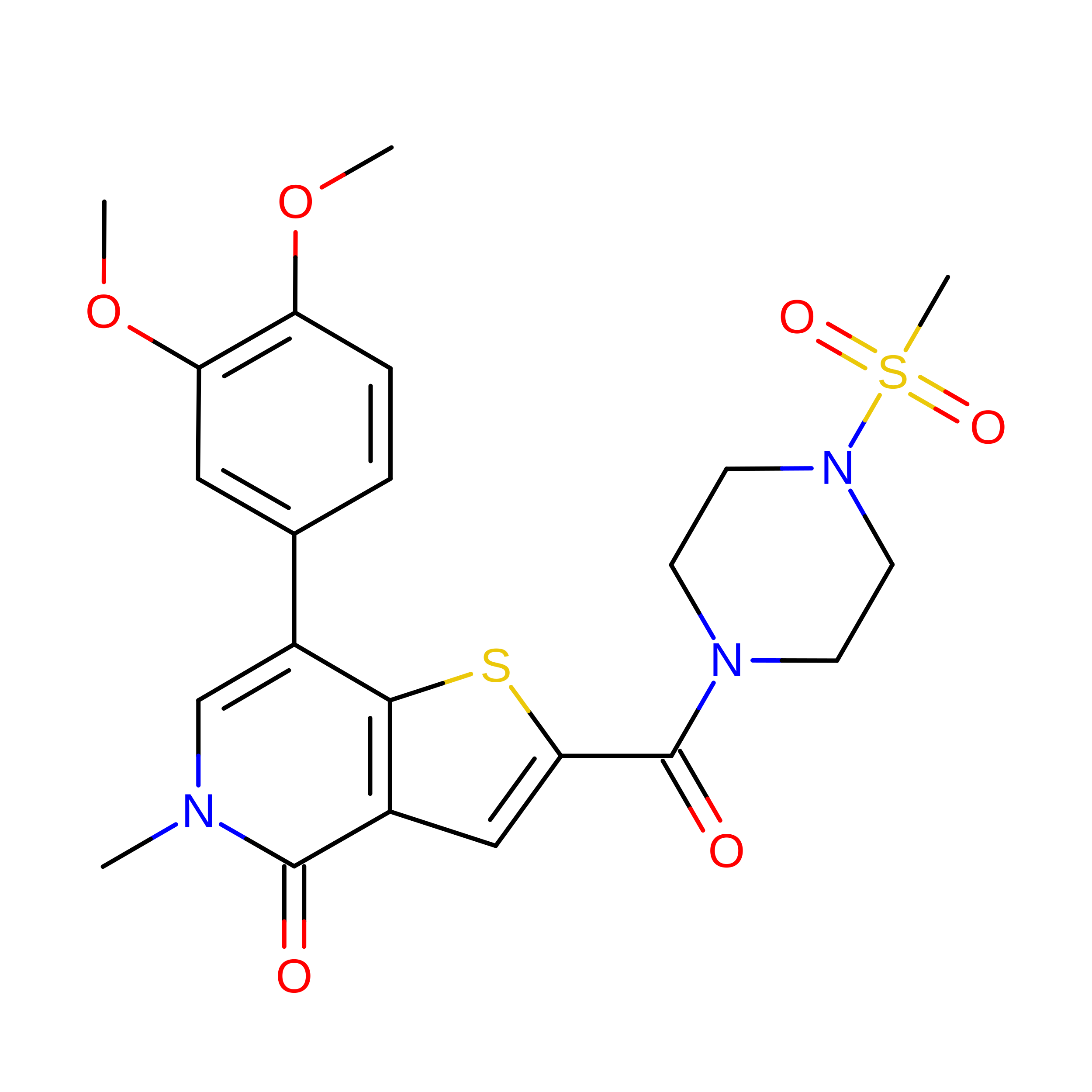
N-TERMINAL BROMODOMAIN OF HUMAN BRD4 WITH 7-(3,4-dimethoxyphenyl)-2-(4-methanesulfonylpiperazine-1-carbonyl)-5-methyl-4H,5H-thieno-3,2-c- pyridin-4-one


Experimental Data Snapshot

  • Method: X-RAY DIFFRACTION
  • Resolution: 1.19 Å
  • R-Value Free: 
    0.175 (Depositor), 0.187 (DCC) 
  • R-Value Work: 
    0.167 (Depositor), 0.175 (DCC) 
  • R-Value Observed: 
    0.167 (Depositor) 

wwPDB Validation 3D Report Full Report

Validation slider image for 4UIZ

Ligand Structure Quality Assessment 


This is version 1.2 of the entry. See complete history

Literature

The Discovery of I-Brd9, a Selective Cell Active Chemical Probe for Bromodomain Containing Protein 9 Inhibition.

Theodoulou, N.H.Bamborough, P.Bannister, A.J.Becher, I.Bit, R.A.Che, K.H.Chung, C.Dittmann, A.Drewes, G.Drewry, D.H.Gordon, L.Grandi, P.Leveridge, M.Lindon, M.Michon, A.Molnar, J.Robson, S.C.Tomkinson, N.C.O.Kouzarides, T.Prinjha, R.K.Humphreys, P.G.

(2016) J Med Chem 59: 1425

  • DOI: https://doi.org/10.1021/acs.jmedchem.5b00256
  • Primary Citation Related Structures: 
    4UIT, 4UIU, 4UIV, 4UIW, 4UIX, 4UIY, 4UIZ

  • PubMed Abstract: 

    Acetylation of histone lysine residues is one of the most well-studied post-translational modifications of chromatin, selectively recognized by bromodomain "reader" modules. Inhibitors of the bromodomain and extra terminal domain (BET) family of bromodomains have shown profound anticancer and anti-inflammatory properties, generating much interest in targeting other bromodomain-containing proteins for disease treatment. Herein, we report the discovery of I-BRD9, the first selective cellular chemical probe for bromodomain-containing protein 9 (BRD9). I-BRD9 was identified through structure-based design, leading to greater than 700-fold selectivity over the BET family and 200-fold over the highly homologous bromodomain-containing protein 7 (BRD7). I-BRD9 was used to identify genes regulated by BRD9 in Kasumi-1 cells involved in oncology and immune response pathways and to the best of our knowledge, represents the first selective tool compound available to elucidate the cellular phenotype of BRD9 bromodomain inhibition.


  • Organizational Affiliation
    • Epinova Discovery Performance Unit, GlaxoSmithKline R&D , Stevenage, Hertfordshire SG1 2NY, U.K.

Macromolecule Content 

  • Total Structure Weight: 15.72 kDa 
  • Atom Count: 1,449 
  • Modeled Residue Count: 127 
  • Deposited Residue Count: 127 
  • Unique protein chains: 1

Macromolecules

Find similar proteins by:|  3D Structure
Entity ID: 1
MoleculeChains  Sequence LengthOrganismDetailsImage
BROMODOMAIN-CONTAINING PROTEIN 4127Homo sapiensMutation(s): 0 
UniProt & NIH Common Fund Data Resources
Find proteins for O60885 (Homo sapiens)
Explore O60885 
Go to UniProtKB:  O60885
PHAROS:  O60885
GTEx:  ENSG00000141867 
Entity Groups
Sequence Clusters30% Identity50% Identity70% Identity90% Identity95% Identity100% Identity
UniProt GroupO60885
Sequence Annotations
Expand
Reference Sequence

Small Molecules

Experimental Data & Validation

Experimental Data

  • Method: X-RAY DIFFRACTION
  • Resolution: 1.19 Å
  • R-Value Free:  0.175 (Depositor), 0.187 (DCC) 
  • R-Value Work:  0.167 (Depositor), 0.175 (DCC) 
  • R-Value Observed: 0.167 (Depositor) 
Space Group: P 21 21 21
Unit Cell:
Length ( Å )Angle ( ˚ )
a = 37.373α = 90
b = 44.555β = 90
c = 78.698γ = 90
Software Package:
Software NamePurpose
REFMACrefinement
XDSdata reduction
SCALAdata scaling

Structure Validation

View Full Validation Report


Ligand Structure Quality Assessment 


Entry History 

Deposition Data

Revision History  (Full details and data files)

  • Version 1.0: 2015-04-22
    Type: Initial release
  • Version 1.1: 2016-03-09
    Changes: Database references
  • Version 1.2: 2024-05-08
    Changes: Data collection, Database references, Derived calculations, Other