5JYP | pdb_00005jyp

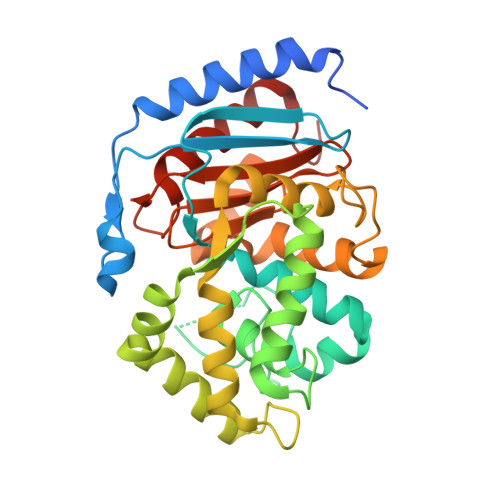
Allosteric inhibition of Kidney Isoform of Glutaminase


Experimental Data Snapshot

  • Method: X-RAY DIFFRACTION
  • Resolution: 2.74 Å
  • R-Value Free: 
    0.245 (Depositor), 0.228 (DCC) 
  • R-Value Work: 
    0.209 (Depositor) 
  • R-Value Observed: 
    0.212 (Depositor) 

Starting Model: experimental
View more details

wwPDB Validation 3D Report Full Report

Validation slider image for 5JYP

Ligand Structure Quality Assessment 


This is version 1.2 of the entry. See complete history

Literature

Structural basis for exploring the allosteric inhibition of human kidney type glutaminase.

Ramachandran, S.Pan, C.Q.Zimmermann, S.C.Duvall, B.Tsukamoto, T.Low, B.C.Sivaraman, J.

(2016) Oncotarget 7: 57943-57954

  • DOI: https://doi.org/10.18632/oncotarget.10791
  • Primary Citation Related Structures: 
    5JYO, 5JYP

  • PubMed Abstract: 

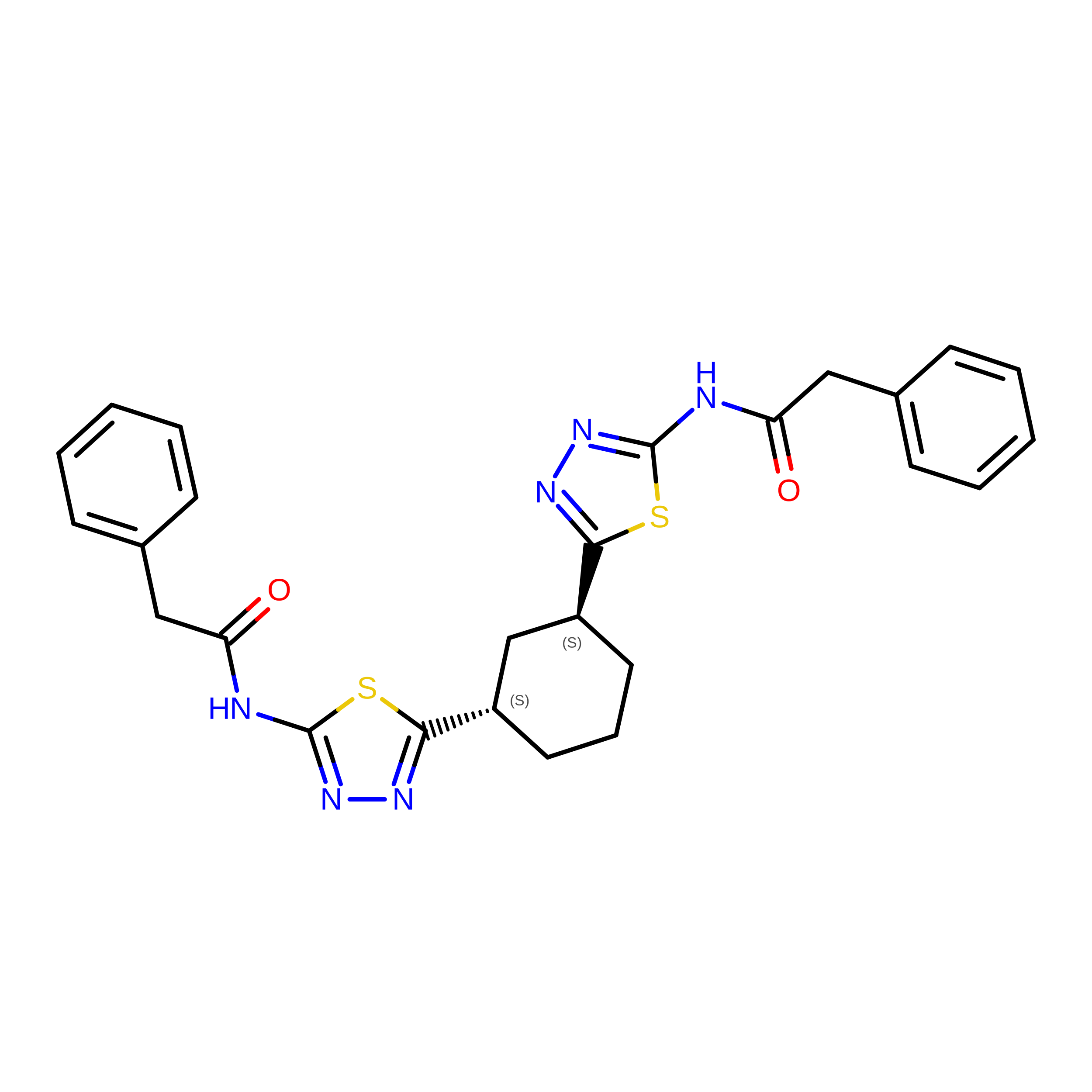
    Cancer cells employ glutaminolysis to provide a source of intermediates for their upregulated biosynthetic needs. Glutaminase, which catalyzes the conversion of glutamine to glutamate, is gaining increasing attention as a potential drug target. Small-molecule inhibitors such as BPTES and CB-839, which target the allosteric site of glutaminase with high specificity, demonstrate immense promise as anti-tumor drugs. Here, we report the study of a new BPTES analog, N,N'-(5,5'-(trans-cyclohexane-1,3-diyl)bis(1,3,4-tiadiazole-5,2-diyl))bis(2-phenylacetamide) (trans-CBTBP), and compared its inhibitory effect against that of CB-839 and BPTES. We show that CB-839 has a 30- and 50-fold lower IC50 than trans-CBTBP and BPTES, respectively. To explore the structural basis for the differences in their inhibitory efficacy, we solved the complex structures of cKGA with 1S, 3S-CBTBP and CB-839. We found that CB-839 produces a greater degree of interaction with cKGA than 1S, 3S-CBTBP or BPTES. The results of this study will facilitate the rational design of new KGA inhibitors to better treat glutamine-addicted cancers.


  • Organizational Affiliation
    • Department of Biological Sciences, National University of Singapore, 117543, Singapore.

Macromolecule Content 

  • Total Structure Weight: 37.15 kDa 
  • Atom Count: 2,421 
  • Modeled Residue Count: 308 
  • Deposited Residue Count: 333 
  • Unique protein chains: 1

Macromolecules

Find similar proteins by:|  3D Structure
Entity ID: 1
MoleculeChains  Sequence LengthOrganismDetailsImage
Glutaminase kidney isoform, mitochondrial333Homo sapiensMutation(s): 0 
Gene Names: GLSGLS1KIAA0838
EC: 3.5.1.2
UniProt & NIH Common Fund Data Resources
Find proteins for O94925 (Homo sapiens)
Explore O94925 
Go to UniProtKB:  O94925
PHAROS:  O94925
GTEx:  ENSG00000115419 
Entity Groups
Sequence Clusters30% Identity50% Identity70% Identity90% Identity95% Identity100% Identity
UniProt GroupO94925
Sequence Annotations
Expand
Reference Sequence

Small Molecules

Ligands 1 Unique
IDChains Name / Formula / InChI Key2D Diagram3D Interactions
ZBS

Query on ZBS


Download:Ideal Coordinates CCD File
B [auth A]2-phenyl-~{N}-[5-[(1~{S},3~{S})-3-[5-(2-phenylethanoylamino)-1,3,4-thiadiazol-2-yl]cyclohexyl]-1,3,4-thiadiazol-2-yl]ethanamide
C26 H26 N6 O2 S2
CZRVPWLXPUBTMI-PMACEKPBSA-N
Binding Affinity Annotations 
IDSourceBinding Affinity
ZBS BindingDB:  5JYP IC50: min: 100, max: 280 (nM) from 2 assay(s)

Experimental Data & Validation

Experimental Data

  • Method: X-RAY DIFFRACTION
  • Resolution: 2.74 Å
  • R-Value Free:  0.245 (Depositor), 0.228 (DCC) 
  • R-Value Work:  0.209 (Depositor) 
  • R-Value Observed: 0.212 (Depositor) 
Space Group: I 41 2 2
Unit Cell:
Length ( Å )Angle ( ˚ )
a = 139.556α = 90
b = 139.556β = 90
c = 156.613γ = 90
Software Package:
Software NamePurpose
PHENIXrefinement
HKL-2000data reduction
HKL-2000data scaling
PHASERphasing

Structure Validation

View Full Validation Report


Ligand Structure Quality Assessment 


Entry History 

& Funding Information

Deposition Data


Funding OrganizationLocationGrant Number
Ministry of Education (MoE, Singapore)SingaporeTier-2 grant R154-000-625-112

Revision History  (Full details and data files)

  • Version 1.0: 2016-08-03
    Type: Initial release
  • Version 1.1: 2019-12-25
    Changes: Author supporting evidence, Database references, Derived calculations
  • Version 1.2: 2023-11-08
    Changes: Data collection, Database references, Experimental preparation, Refinement description