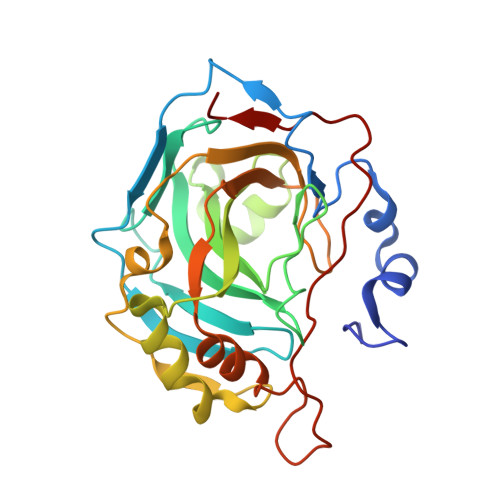
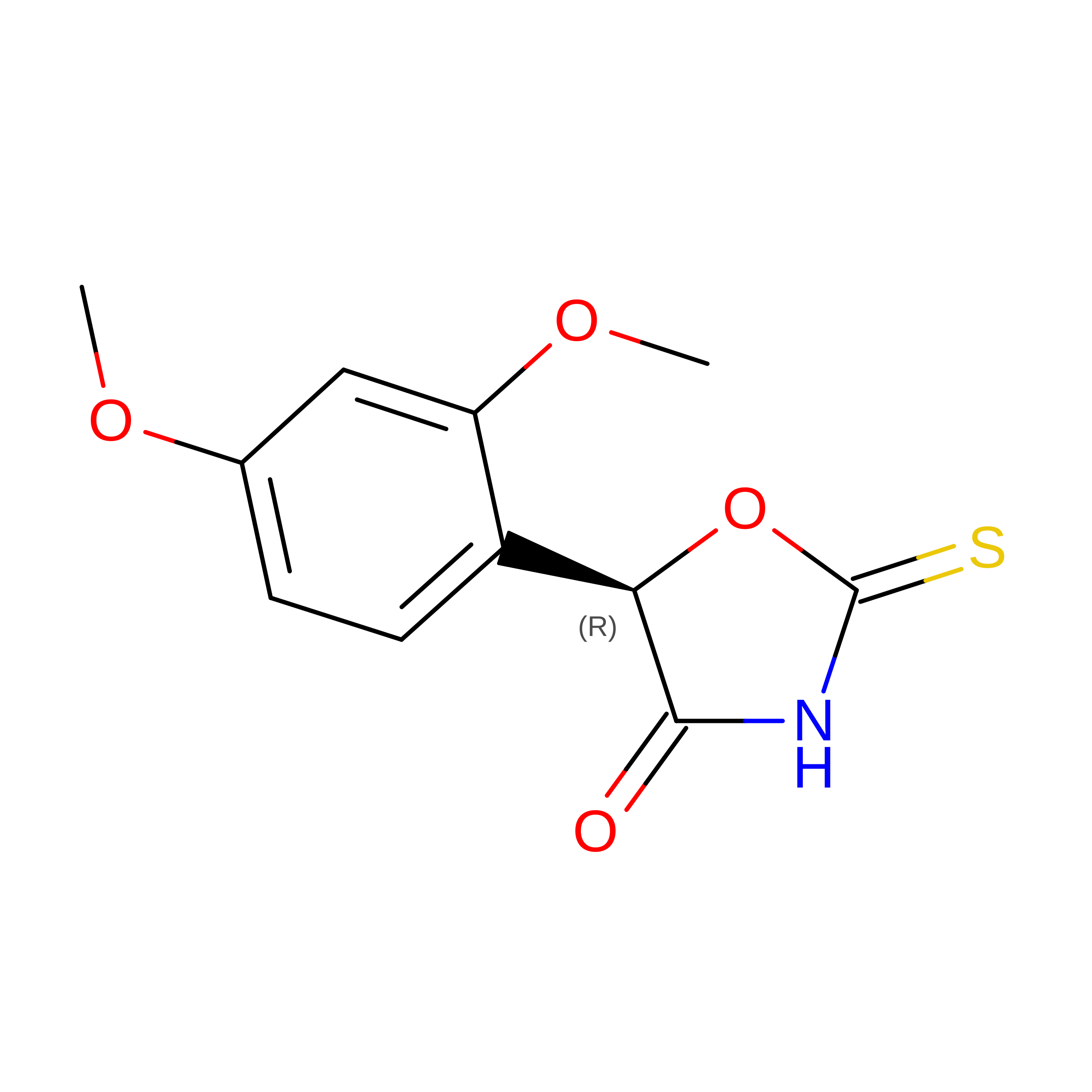
5U0D | pdb_00005u0d

Identification of a New Zinc Binding Chemotype by Fragment Screening


Experimental Data Snapshot

  • Method: X-RAY DIFFRACTION
  • Resolution: 1.59 Å
  • R-Value Free: 
    0.154 (Depositor), 0.154 (DCC) 
  • R-Value Work: 
    0.118 (Depositor), 0.118 (DCC) 
  • R-Value Observed: 
    0.120 (Depositor) 

Starting Model: experimental
View more details

wwPDB Validation 3D Report Full Report

Validation slider image for 5U0D

Ligand Structure Quality Assessment 


This is version 1.2 of the entry. See complete history

Literature

Identification of a New Zinc Binding Chemotype by Fragment Screening.

Chrysanthopoulos, P.K.Mujumdar, P.Woods, L.A.Dolezal, O.Ren, B.Peat, T.S.Poulsen, S.A.

(2017) J Med Chem 60: 7333-7349

  • DOI: https://doi.org/10.1021/acs.jmedchem.7b00606
  • Primary Citation Related Structures: 
    5TXY, 5TY1, 5TY8, 5TY9, 5TYA, 5U0D, 5U0E, 5U0F, 5U0G, 5VGY

  • PubMed Abstract: 

    The discovery of a new zinc binding chemotype from screening a nonbiased fragment library is reported. Using the orthogonal fragment screening methods of native state mass spectrometry and surface plasmon resonance a 3-unsubstituted 2,4-oxazolidinedione fragment was found to have low micromolar binding affinity to the zinc metalloenzyme carbonic anhydrase II (CA II). This affinity approached that of fragment sized primary benzenesulfonamides, the classical zinc binding group found in most CA II inhibitors. Protein X-ray crystallography established that 3-unsubstituted 2,4-oxazolidinediones bound to CA II via an interaction of the acidic ring nitrogen with the CA II active site zinc, as well as two hydrogen bonds between the oxazolidinedione ring oxygen and the CA II protein backbone. Furthermore, 3-unsubstituted 2,4-oxazolidinediones appear to be a viable starting point for the development of an alternative class of CA inhibitor, wherein the medicinal chemistry pedigree of primary sulfonamides has dominated for several decades.


  • Organizational Affiliation
    • Griffith University , Griffith Institute for Drug Discovery, Nathan, Brisbane, Queensland 4111, Australia.

Macromolecule Content 

  • Total Structure Weight: 29.7 kDa 
  • Atom Count: 2,488 
  • Modeled Residue Count: 258 
  • Deposited Residue Count: 260 
  • Unique protein chains: 1

Macromolecules

Find similar proteins by:|  3D Structure
Entity ID: 1
MoleculeChains  Sequence LengthOrganismDetailsImage
Carbonic anhydrase 2260Homo sapiensMutation(s): 0 
Gene Names: CA2
EC: 4.2.1.1 (PDB Primary Data), 4.2.1.69 (UniProt)
UniProt & NIH Common Fund Data Resources
Find proteins for P00918 (Homo sapiens)
Explore P00918 
Go to UniProtKB:  P00918
PHAROS:  P00918
GTEx:  ENSG00000104267 
Entity Groups
Sequence Clusters30% Identity50% Identity70% Identity90% Identity95% Identity100% Identity
UniProt GroupP00918
Sequence Annotations
Expand
Reference Sequence

Experimental Data & Validation

Experimental Data

  • Method: X-RAY DIFFRACTION
  • Resolution: 1.59 Å
  • R-Value Free:  0.154 (Depositor), 0.154 (DCC) 
  • R-Value Work:  0.118 (Depositor), 0.118 (DCC) 
  • R-Value Observed: 0.120 (Depositor) 
Space Group: P 1 21 1
Unit Cell:
Length ( Å )Angle ( ˚ )
a = 42.567α = 90
b = 41.341β = 104.47
c = 72.094γ = 90
Software Package:
Software NamePurpose
REFMACrefinement
XDSdata reduction
Aimlessdata scaling
PHASERphasing

Structure Validation

View Full Validation Report


Ligand Structure Quality Assessment 


Entry History 

Deposition Data

Revision History  (Full details and data files)

  • Version 1.0: 2017-08-30
    Type: Initial release
  • Version 1.1: 2017-09-27
    Changes: Database references
  • Version 1.2: 2023-10-04
    Changes: Data collection, Database references, Refinement description