5V3Q | pdb_00005v3q

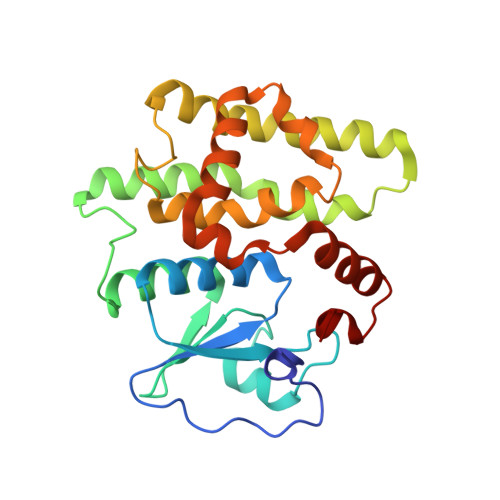
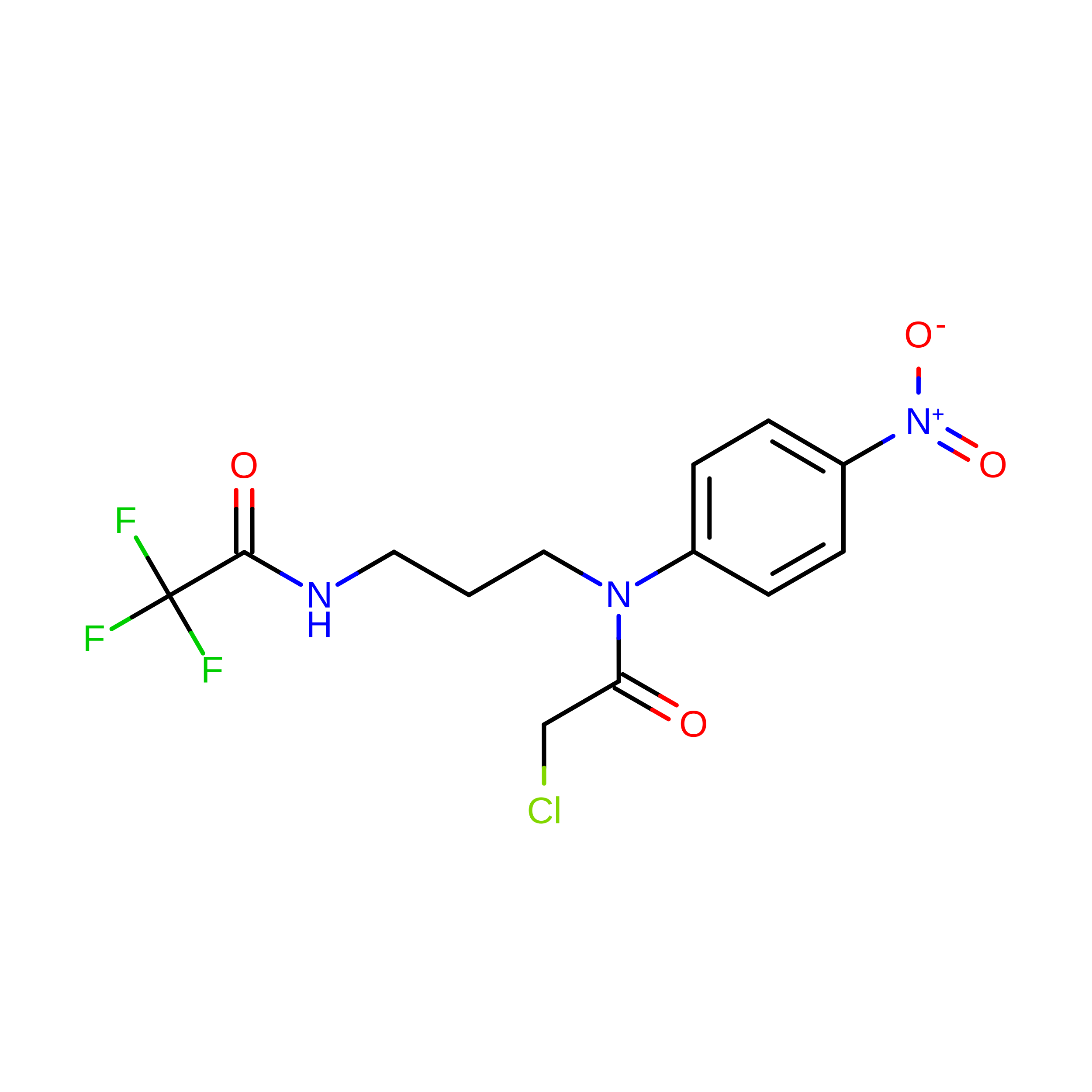
Human GSTO1-1 complexed with ML175


Experimental Data Snapshot

  • Method: X-RAY DIFFRACTION
  • Resolution: 2.25 Å
  • R-Value Free: 
    0.233 (Depositor), 0.236 (DCC) 
  • R-Value Work: 
    0.170 (Depositor), 0.178 (DCC) 
  • R-Value Observed: 
    0.173 (Depositor) 

Starting Model: experimental
View more details

wwPDB Validation 3D Report Full Report

Validation slider image for 5V3Q

Ligand Structure Quality Assessment 


This is version 2.2 of the entry. See complete history

Literature

GSTO1-1 plays a pro-inflammatory role in models of inflammation, colitis and obesity.

Menon, D.Innes, A.Oakley, A.J.Dahlstrom, J.E.Jensen, L.M.Brustle, A.Tummala, P.Rooke, M.Casarotto, M.G.Baell, J.B.Nguyen, N.Xie, Y.Cuellar, M.Strasser, J.Dahlin, J.L.Walters, M.A.Burgio, G.O'Neill, L.A.J.Board, P.G.

(2017) Sci Rep 7: 17832-17832

  • DOI: https://doi.org/10.1038/s41598-017-17861-6
  • Primary Citation Related Structures: 
    5V3Q

  • PubMed Abstract: 

    Glutathione transferase Omega 1 (GSTO1-1) is an atypical GST reported to play a pro-inflammatory role in response to LPS. Here we show that genetic knockout of Gsto1 alters the response of mice to three distinct inflammatory disease models. GSTO1-1 deficiency ameliorates the inflammatory response stimulated by LPS and attenuates the inflammatory impact of a high fat diet on glucose tolerance and insulin resistance. In contrast, GSTO1-1 deficient mice show a more severe inflammatory response and increased escape of bacteria from the colon into the lymphatic system in a dextran sodium sulfate mediated model of inflammatory bowel disease. These responses are similar to those of TLR4 and MyD88 deficient mice in these models and confirm that GSTO1-1 is critical for a TLR4-like pro-inflammatory response in vivo. In wild-type mice, we show that a small molecule inhibitor that covalently binds in the active site of GSTO1-1 can be used to ameliorate the inflammatory response to LPS. Our findings demonstrate the potential therapeutic utility of GSTO1-1 inhibitors in the modulation of inflammation and suggest their possible application in the treatment of a range of inflammatory conditions.


  • Organizational Affiliation
    • John Curtin School of Medical Research, Australian National University, Canberra, ACT 2600, Australia.

Macromolecule Content 

  • Total Structure Weight: 28.16 kDa 
  • Atom Count: 2,112 
  • Modeled Residue Count: 239 
  • Deposited Residue Count: 241 
  • Unique protein chains: 1

Macromolecules

Find similar proteins by:|  3D Structure
Entity ID: 1
MoleculeChains  Sequence LengthOrganismDetailsImage
Glutathione S-transferase omega-1241Homo sapiensMutation(s): 0 
Gene Names: GSTO1GSTTLP28
EC: 2.5.1.18 (PDB Primary Data), 1.8.5.1 (PDB Primary Data), 1.20.4.2 (PDB Primary Data)
UniProt & NIH Common Fund Data Resources
Find proteins for P78417 (Homo sapiens)
Explore P78417 
Go to UniProtKB:  P78417
PHAROS:  P78417
GTEx:  ENSG00000148834 
Entity Groups
Sequence Clusters30% Identity50% Identity70% Identity90% Identity95% Identity100% Identity
UniProt GroupP78417
Sequence Annotations
Expand
Reference Sequence

Small Molecules

Binding Affinity Annotations 
IDSourceBinding Affinity
MLX BindingDB:  5V3Q IC50: 28 (nM) from 1 assay(s)

Experimental Data & Validation

Experimental Data

  • Method: X-RAY DIFFRACTION
  • Resolution: 2.25 Å
  • R-Value Free:  0.233 (Depositor), 0.236 (DCC) 
  • R-Value Work:  0.170 (Depositor), 0.178 (DCC) 
  • R-Value Observed: 0.173 (Depositor) 
Space Group: P 31 2 1
Unit Cell:
Length ( Å )Angle ( ˚ )
a = 57.103α = 90
b = 57.103β = 90
c = 139.613γ = 120
Software Package:
Software NamePurpose
REFMACrefinement
DENZOdata reduction
SCALEPACKdata scaling
PHASERphasing

Structure Validation

View Full Validation Report


Ligand Structure Quality Assessment 


Entry History 

Deposition Data

  • Released Date: 2017-12-20 
  • Deposition Author(s): Oakley, A.J.

Revision History  (Full details and data files)

  • Version 1.0: 2017-12-20
    Type: Initial release
  • Version 1.1: 2018-01-03
    Changes: Database references
  • Version 1.2: 2018-04-18
    Changes: Data collection
  • Version 2.0: 2022-04-13
    Changes: Database references, Non-polymer description, Structure summary
  • Version 2.1: 2023-10-04
    Changes: Data collection, Refinement description
  • Version 2.2: 2024-11-20
    Changes: Structure summary