5WF5 | pdb_00005wf5

Agonist bound human A2a adenosine receptor with D52N mutation at 2.60 A resolution


Experimental Data Snapshot

  • Method: X-RAY DIFFRACTION
  • Resolution: 2.60 Å
  • R-Value Free: 
    0.251 (Depositor), 0.251 (DCC) 
  • R-Value Work: 
    0.214 (Depositor), 0.218 (DCC) 
  • R-Value Observed: 
    0.216 (Depositor) 

Starting Model: experimental
View more details

wwPDB Validation 3D Report Full Report

Validation slider image for 5WF5

Ligand Structure Quality Assessment 


This is version 1.2 of the entry. See complete history

Literature

Structural Connection between Activation Microswitch and Allosteric Sodium Site in GPCR Signaling.

White, K.L.Eddy, M.T.Gao, Z.G.Han, G.W.Lian, T.Deary, A.Patel, N.Jacobson, K.A.Katritch, V.Stevens, R.C.

(2018) Structure 26: 259-269.e5

  • DOI: https://doi.org/10.1016/j.str.2017.12.013
  • Primary Citation Related Structures: 
    5WF5, 5WF6

  • PubMed Abstract: 

    Sodium ions are endogenous allosteric modulators of many G-protein-coupled receptors (GPCRs). Mutation of key residues in the sodium binding motif causes a striking effect on G-protein signaling. We report the crystal structures of agonist complexes for two variants in the first sodium coordination shell of the human A 2A adenosine receptor, D52 2.50 N and S91 3.39 A. Both structures present an overall active-like conformation; however, the variants show key changes in the activation motif NPxxY. Changes in the hydrogen bonding network in this microswitch suggest a possible mechanism for modified G-protein signaling and enhanced thermal stability. These structures, signaling data, and thermal stability analysis with a panel of pharmacological ligands provide a basis for understanding the role of the sodium-coordinating residues on stability and G-protein signaling. Utilizing the D 2.50 N variant is a promising method for stabilizing class A GPCRs to accelerate structural efforts and drug discovery.


  • Organizational Affiliation
    • Departments of Biological Sciences and Chemistry, Bridge Institute, USC Michelson Center, University of Southern California, 1002 West Childs Way, Los Angeles, CA 90089, USA.

Macromolecule Content 

  • Total Structure Weight: 58.05 kDa 
  • Atom Count: 3,565 
  • Modeled Residue Count: 444 
  • Deposited Residue Count: 504 
  • Unique protein chains: 1

Macromolecules

Find similar proteins by:|  3D Structure
Entity ID: 1
MoleculeChains  Sequence LengthOrganismDetailsImage
Human A2a adenosine receptor T4L chimera504Homo sapiensTequatrovirus T4Mutation(s): 5 
Gene Names: ADORA2AADORA2
EC: 3.2.1.17
Membrane Entity: Yes 
UniProt & NIH Common Fund Data Resources
Find proteins for P00720 (Enterobacteria phage T4)
Explore P00720 
Go to UniProtKB:  P00720
Find proteins for P29274 (Homo sapiens)
Explore P29274 
Go to UniProtKB:  P29274
PHAROS:  P29274
GTEx:  ENSG00000128271 
Entity Groups
Sequence Clusters30% Identity50% Identity70% Identity90% Identity95% Identity100% Identity
UniProt GroupsP00720P29274
Sequence Annotations
Expand
Reference Sequence

Small Molecules

Ligands 2 Unique
IDChains Name / Formula / InChI Key2D Diagram3D Interactions
UKA

Query on UKA


Download:Ideal Coordinates CCD File
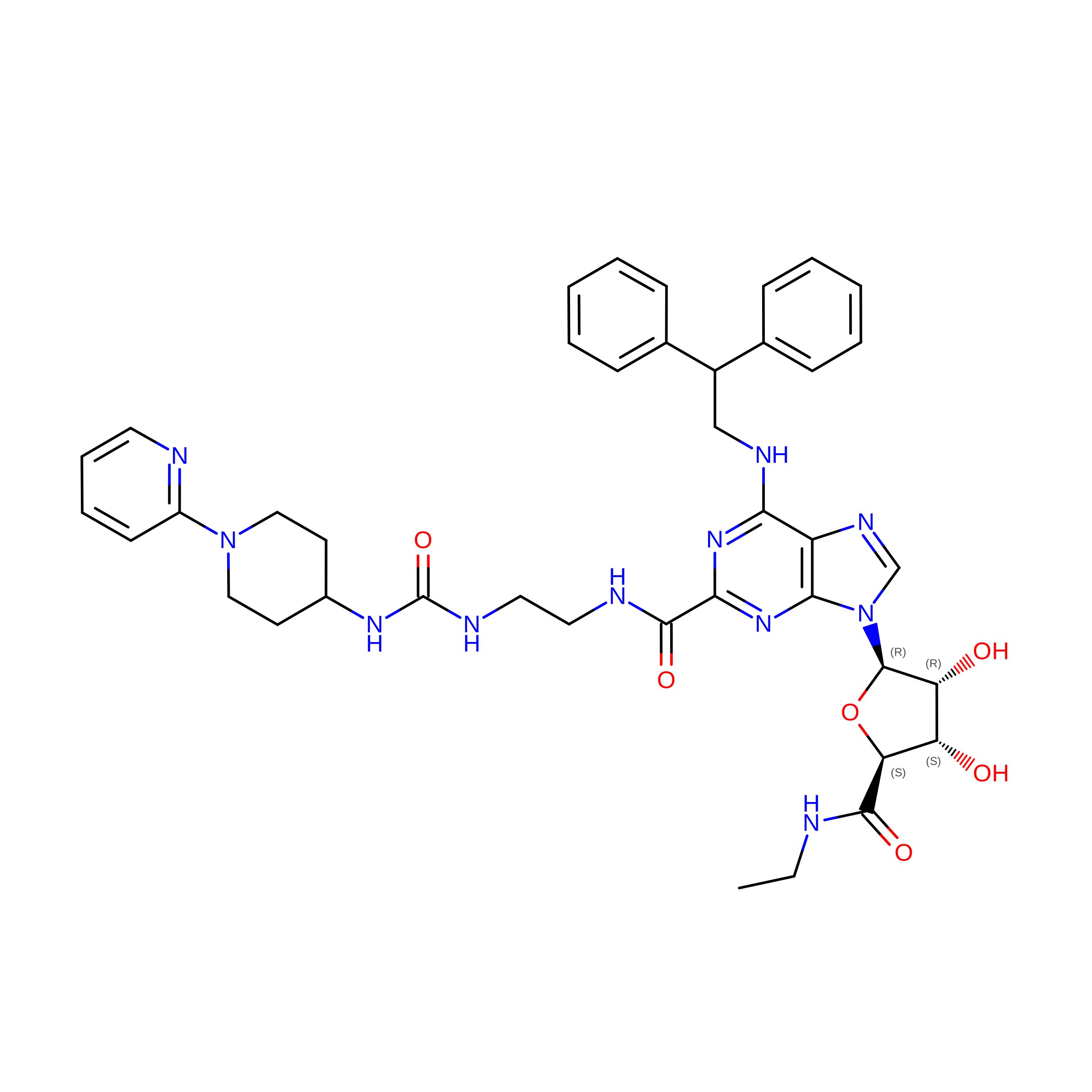
B [auth A]6-(2,2-diphenylethylamino)-9-[(2R,3R,4S,5S)-5-(ethylcarbamoyl)-3,4-dihydroxy-oxolan-2-yl]-N-[2-[(1-pyridin-2-ylpiperidin-4-yl)carbamoylamino]ethyl]purine-2-carboxamide
C40 H47 N11 O6
ZOTHAEBAWXWVID-HXEFRTELSA-N
OLC
(Subject of Investigation/LOI)

Query on OLC


Download:Ideal Coordinates CCD File
C [auth A],
D [auth A]
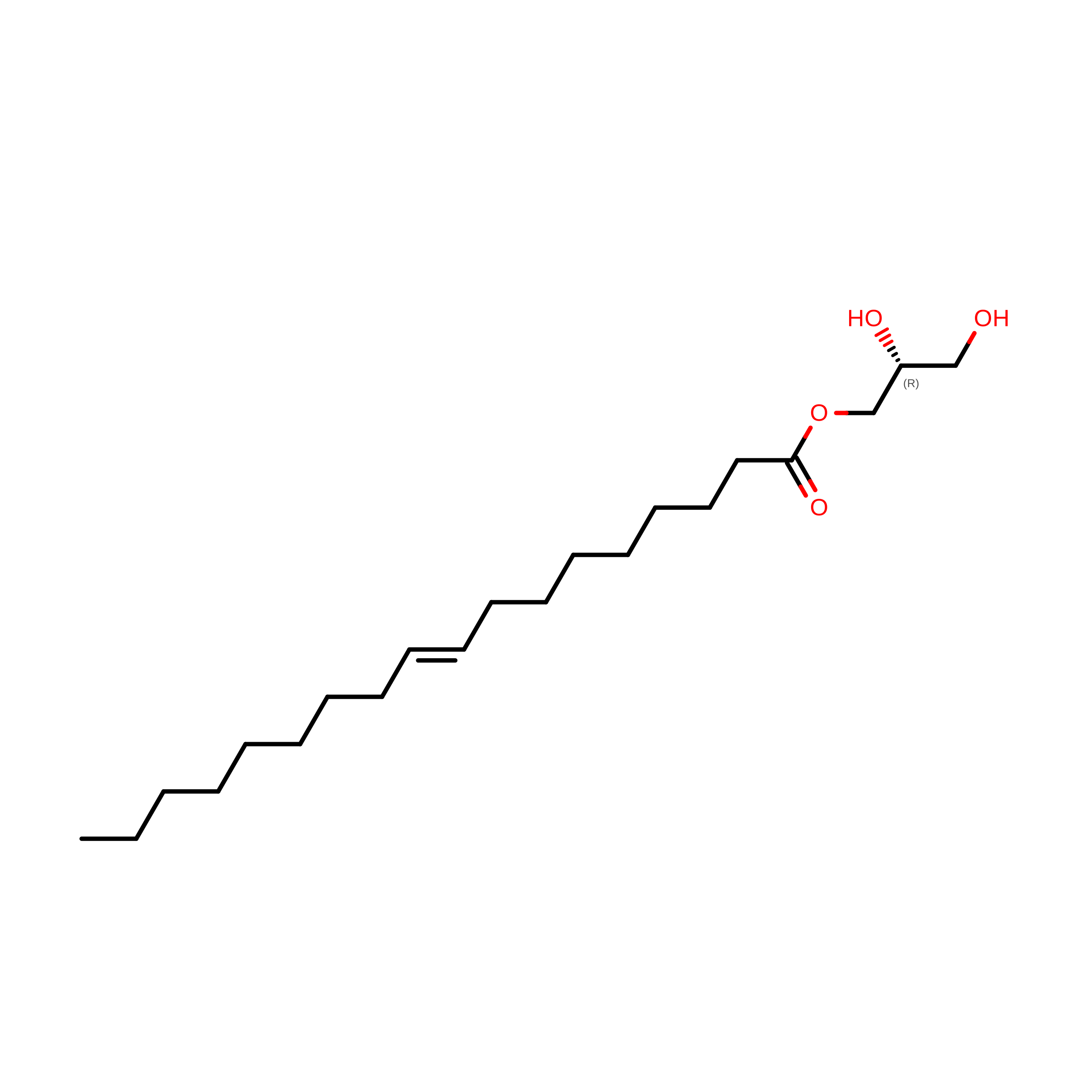
(2R)-2,3-dihydroxypropyl (9Z)-octadec-9-enoate
C21 H40 O4
RZRNAYUHWVFMIP-GDCKJWNLSA-N

Experimental Data & Validation

Experimental Data

  • Method: X-RAY DIFFRACTION
  • Resolution: 2.60 Å
  • R-Value Free:  0.251 (Depositor), 0.251 (DCC) 
  • R-Value Work:  0.214 (Depositor), 0.218 (DCC) 
  • R-Value Observed: 0.216 (Depositor) 
Space Group: P 1 21 1
Unit Cell:
Length ( Å )Angle ( ˚ )
a = 47.686α = 90
b = 77.769β = 101.05
c = 86.488γ = 90
Software Package:
Software NamePurpose
PHENIXrefinement
DENZOdata reduction
SCALEPACKdata scaling
PHASERphasing

Structure Validation

View Full Validation Report


Ligand Structure Quality Assessment 


Entry History 

Deposition Data

Revision History  (Full details and data files)

  • Version 1.0: 2018-02-21
    Type: Initial release
  • Version 1.1: 2023-10-04
    Changes: Data collection, Database references, Refinement description
  • Version 1.2: 2024-10-16
    Changes: Structure summary