5XYZ | pdb_00005xyz

The structure of human BTK kinase domain in complex with a covalent inhibitor


Experimental Data Snapshot

  • Method: X-RAY DIFFRACTION
  • Resolution: 2.64 Å
  • R-Value Free: 
    0.326 (Depositor), 0.327 (DCC) 
  • R-Value Work: 
    0.265 (Depositor), 0.270 (DCC) 
  • R-Value Observed: 
    0.268 (Depositor) 

Starting Model: experimental
View more details

wwPDB Validation 3D Report Full Report

Validation slider image for 5XYZ

Ligand Structure Quality Assessment 


This is version 1.2 of the entry. See complete history

Literature

In Silico Identification of a Novel Hinge-Binding Scaffold for Kinase Inhibitor Discovery.

Wang, Y.Sun, Y.Cao, R.Liu, D.Xie, Y.Li, L.Qi, X.Huang, N.

(2017) J Med Chem 60: 8552-8564

  • DOI: https://doi.org/10.1021/acs.jmedchem.7b01075
  • Primary Citation Related Structures: 
    5XYX, 5XYY, 5XYZ

  • PubMed Abstract: 

    To explore novel kinase hinge-binding scaffolds, we carried out structure-based virtual screening against p38α MAPK as a model system. With the assistance of developed kinase-specific structural filters, we identify a novel lead compound that selectively inhibits a panel of kinases with threonine as the gatekeeper residue, including BTK and LCK. These kinases play important roles in lymphocyte activation, which encouraged us to design novel kinase inhibitors as drug candidates for ameliorating inflammatory diseases and cancers. Therefore, we chemically modified our substituted triazole-class lead compound to improve the binding affinity and selectivity via a "minimal decoration" strategy, which resulted in potent and selective kinase inhibitors against LCK (18 nM) and BTK (8 nM). Subsequent crystallographic experiments validated our design. These rationally designed compounds exhibit potent on-target inhibition against BTK in B cells or LCK in T cells, respectively. Our work demonstrates that structure-based virtual screening can be applied to facilitate the development of novel chemical entities in crowded chemical space in the field of kinase inhibitor discovery.


  • Organizational Affiliation
    • National Institute of Biological Sciences, Beijing , No. 7 Science Park Road, Zhongguancun Life Science Park, Beijing 102206, China.

Macromolecule Content 

  • Total Structure Weight: 62.59 kDa 
  • Atom Count: 3,814 
  • Modeled Residue Count: 464 
  • Deposited Residue Count: 530 
  • Unique protein chains: 1

Macromolecules

Find similar proteins by:|  3D Structure
Entity ID: 1
MoleculeChains  Sequence LengthOrganismDetailsImage
Tyrosine-protein kinase BTK
A, B
265Homo sapiensMutation(s): 0 
Gene Names: BTKAGMX1ATKBPK
EC: 2.7.10.2
UniProt & NIH Common Fund Data Resources
Find proteins for Q06187 (Homo sapiens)
Explore Q06187 
Go to UniProtKB:  Q06187
PHAROS:  Q06187
GTEx:  ENSG00000010671 
Entity Groups
Sequence Clusters30% Identity50% Identity70% Identity90% Identity95% Identity100% Identity
UniProt GroupQ06187
Sequence Annotations
Expand
Reference Sequence

Small Molecules

Ligands 1 Unique
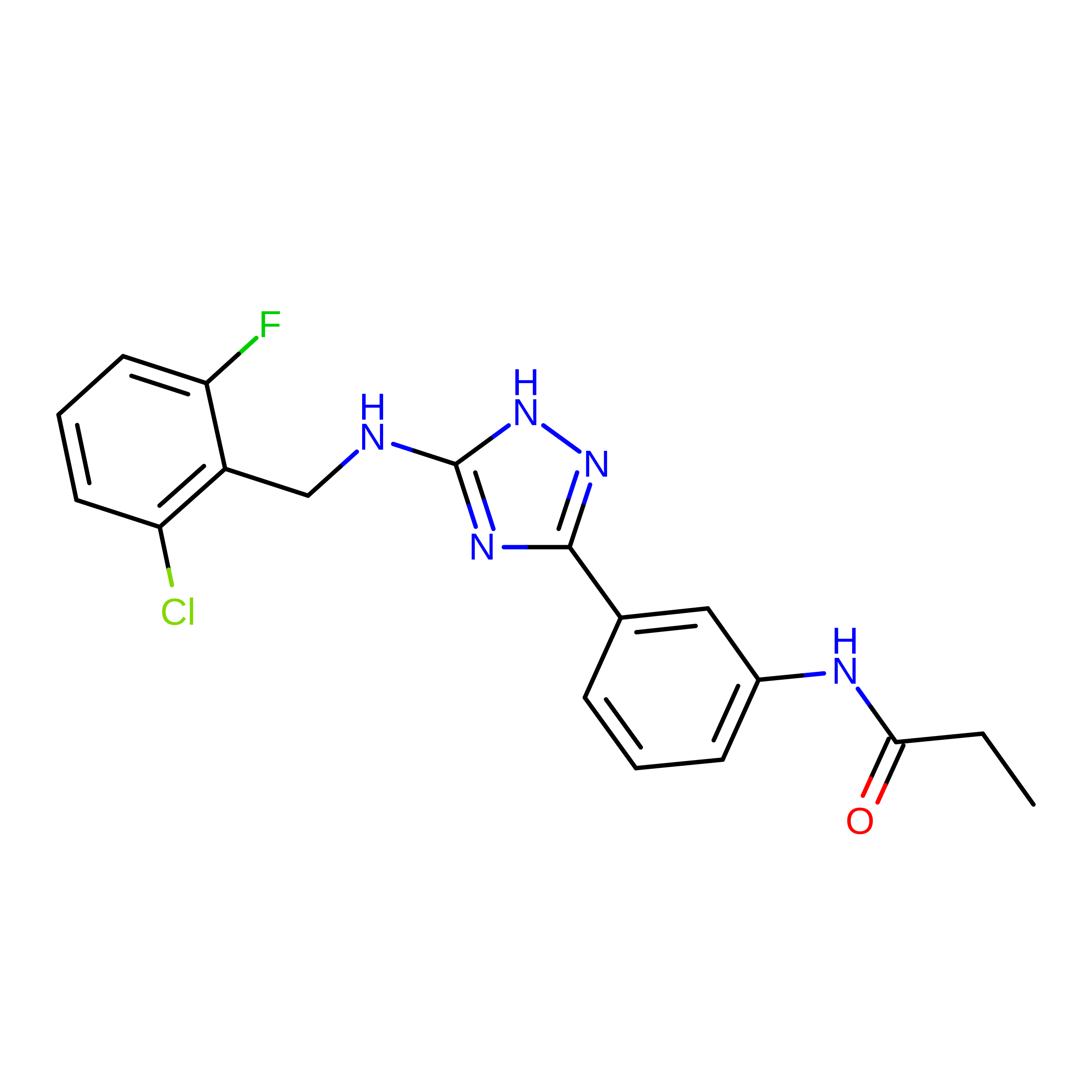
IDChains Name / Formula / InChI Key2D Diagram3D Interactions
GYL

Query on GYL


Download:Ideal Coordinates CCD File
C [auth A],
D [auth B]
N-[3-(5-{[(2-chloro-6-fluorophenyl)methyl]amino}-1H-1,2,4-triazol-3-yl)phenyl]propanamide
C18 H17 Cl F N5 O
RBMCVMVCNBYBCI-UHFFFAOYSA-N

Experimental Data & Validation

Experimental Data

  • Method: X-RAY DIFFRACTION
  • Resolution: 2.64 Å
  • R-Value Free:  0.326 (Depositor), 0.327 (DCC) 
  • R-Value Work:  0.265 (Depositor), 0.270 (DCC) 
  • R-Value Observed: 0.268 (Depositor) 
Space Group: P 1 21 1
Unit Cell:
Length ( Å )Angle ( ˚ )
a = 59.59α = 90
b = 53.6β = 100.04
c = 101.635γ = 90
Software Package:
Software NamePurpose
REFMACrefinement
HKL-2000data reduction
SCALEPACKdata scaling
PHASERphasing

Structure Validation

View Full Validation Report


Ligand Structure Quality Assessment 


Entry History 

Deposition Data

Revision History  (Full details and data files)

  • Version 1.0: 2018-05-23
    Type: Initial release
  • Version 1.1: 2023-11-22
    Changes: Data collection, Database references, Refinement description
  • Version 1.2: 2024-11-20
    Changes: Structure summary