6CS9 | pdb_00006cs9

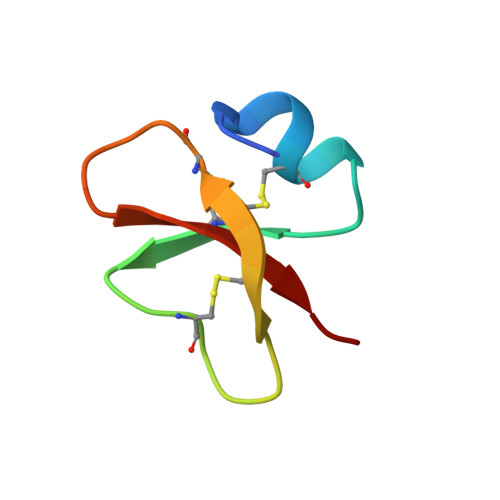
Crystal structure of human beta-defensin 2 in complex with PIP2


Experimental Data Snapshot

  • Method: X-RAY DIFFRACTION
  • Resolution: 1.85 Å
  • R-Value Free: 
    0.227 (Depositor), 0.237 (DCC) 
  • R-Value Work: 
    0.195 (Depositor), 0.198 (DCC) 
  • R-Value Observed: 
    0.196 (Depositor) 

Starting Model: experimental
View more details

wwPDB Validation 3D Report Full Report

Validation slider image for 6CS9

Ligand Structure Quality Assessment 


This is version 1.4 of the entry. See complete history

Literature

Human beta-defensin 2 killsCandida albicansthrough phosphatidylinositol 4,5-bisphosphate-mediated membrane permeabilization.

Jarva, M.Phan, T.K.Lay, F.T.Caria, S.Kvansakul, M.Hulett, M.D.

(2018) Sci Adv 4: eaat0979-eaat0979

  • DOI: https://doi.org/10.1126/sciadv.aat0979
  • Primary Citation Related Structures: 
    6CS9

  • PubMed Abstract: 

    Human defensins belong to a subfamily of the cationic antimicrobial peptides and act as a first line of defense against invading microbes. Their often broad-spectrum antimicrobial and antitumor activities make them attractive for therapeutic development; however, their precise molecular mechanism(s) of action remains to be defined. We show that human β-defensin 2 (HBD-2) permeabilizes Candida albicans cell membranes via a mechanism targeting the plasma membrane lipid phosphatidylinositol 4,5-bisphosphate (PIP 2 ). We determined the structure of HBD-2 bound to PIP 2 , which revealed two distinct PIP 2 -binding sites, and showed, using functional assays, that mutations in these sites ablate PIP 2 -mediated fungal growth inhibition by HBD-2. Our study provides the first insight into lipid-mediated human defensin membrane permeabilization at an atomic level and reveals a unique mode of lipid engagement to permeabilize cell membranes.


  • Organizational Affiliation
    • Department of Biochemistry and Genetics, La Trobe Institute for Molecular Science, La Trobe University, Melbourne, Australia.

Macromolecule Content 

  • Total Structure Weight: 10.18 kDa 
  • Atom Count: 727 
  • Modeled Residue Count: 82 
  • Deposited Residue Count: 82 
  • Unique protein chains: 1

Macromolecules

Find similar proteins by:|  3D Structure
Entity ID: 1
MoleculeChains  Sequence LengthOrganismDetailsImage
Beta-defensin 4A
A, B
41Homo sapiensMutation(s): 0 
Gene Names: DEFB4ADEFB102DEFB2DEFB4DEFB4B
Membrane Entity: Yes 
UniProt & NIH Common Fund Data Resources
Find proteins for O15263 (Homo sapiens)
Explore O15263 
Go to UniProtKB:  O15263
Entity Groups
Sequence Clusters30% Identity50% Identity70% Identity90% Identity95% Identity100% Identity
UniProt GroupO15263
Sequence Annotations
Expand
Reference Sequence

Small Molecules

Ligands 1 Unique
IDChains Name / Formula / InChI Key2D Diagram3D Interactions
PIO
(Subject of Investigation/LOI)

Query on PIO


Download:Ideal Coordinates CCD File
C [auth A],
D [auth B]
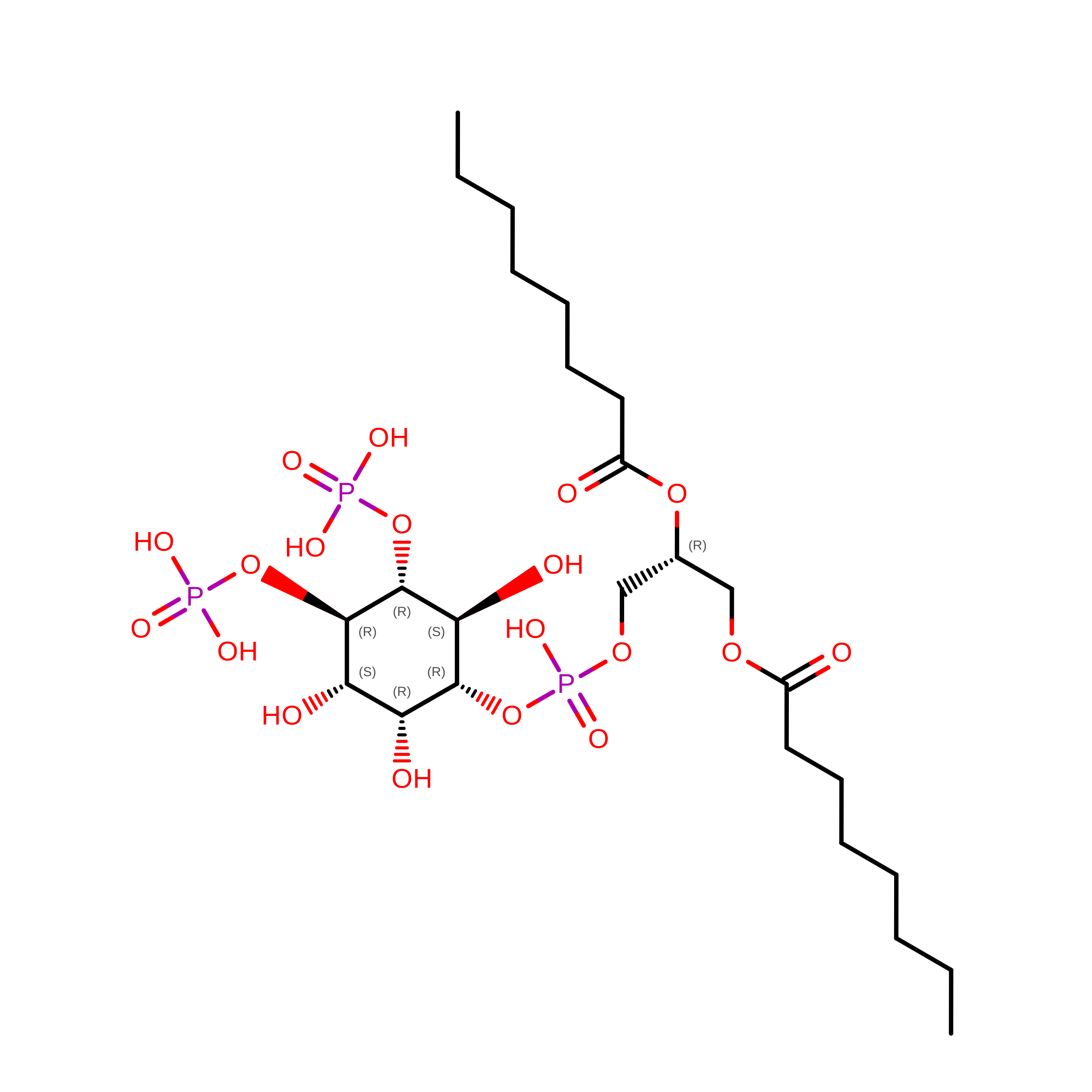
[(2R)-2-octanoyloxy-3-[oxidanyl-[(1R,2R,3S,4R,5R,6S)-2,3,6-tris(oxidanyl)-4,5-diphosphonooxy-cyclohexyl]oxy-phosphoryl]oxy-propyl] octanoate
C25 H49 O19 P3
XLNCEHRXXWQMPK-MJUMVPIBSA-N

Experimental Data & Validation

Experimental Data

  • Method: X-RAY DIFFRACTION
  • Resolution: 1.85 Å
  • R-Value Free:  0.227 (Depositor), 0.237 (DCC) 
  • R-Value Work:  0.195 (Depositor), 0.198 (DCC) 
  • R-Value Observed: 0.196 (Depositor) 
Space Group: P 1 21 1
Unit Cell:
Length ( Å )Angle ( ˚ )
a = 32.871α = 90
b = 25.538β = 98.64
c = 40.17γ = 90
Software Package:
Software NamePurpose
PHENIXrefinement
Aimlessdata scaling
PHASERphasing
XDSdata reduction
Cootmodel building

Structure Validation

View Full Validation Report


Ligand Structure Quality Assessment 


Entry History 

& Funding Information

Deposition Data


Funding OrganizationLocationGrant Number
Australian Research Council (ARC)AustraliaFT130101349

Revision History  (Full details and data files)

  • Version 1.0: 2018-07-25
    Type: Initial release
  • Version 1.1: 2018-08-08
    Changes: Data collection, Database references
  • Version 1.2: 2020-01-01
    Changes: Author supporting evidence
  • Version 1.3: 2023-10-04
    Changes: Data collection, Database references, Refinement description
  • Version 1.4: 2024-11-20
    Changes: Structure summary