6GV0 | pdb_00006gv0

Insulin glulisine


Experimental Data Snapshot

  • Method: X-RAY DIFFRACTION
  • Resolution: 1.26 Å
  • R-Value Free: 
    0.152 (Depositor), 0.152 (DCC) 
  • R-Value Work: 
    0.128 (Depositor), 0.133 (DCC) 
  • R-Value Observed: 
    0.129 (Depositor) 

Starting Model: experimental
View more details

wwPDB Validation 3D Report Full Report

Validation slider image for 6GV0

This is version 1.3 of the entry. See complete history

Literature

Analysis of insulin glulisine at the molecular level by X-ray crystallography and biophysical techniques.

Gillis, R.B.Solomon, H.V.Govada, L.Oldham, N.J.Dinu, V.Jiwani, S.I.Gyasi-Antwi, P.Coffey, F.Meal, A.Morgan, P.S.Harding, S.E.Helliwell, J.R.Chayen, N.E.Adams, G.G.

(2021) Sci Rep 11: 1737-1737

  • DOI: https://doi.org/10.1038/s41598-021-81251-2
  • Primary Citation Related Structures: 
    6GV0

  • PubMed Abstract: 

    This study concerns glulisine, a rapid-acting insulin analogue that plays a fundamental role in diabetes management. We have applied a combination of methods namely X-ray crystallography, and biophysical characterisation to provide a detailed insight into the structure and function of glulisine. X-ray data provided structural information to a resolution of 1.26 Å. Crystals belonged to the H3 space group with hexagonal (centred trigonal) cell dimensions a = b = 82.44 and c = 33.65 Å with two molecules in the asymmetric unit. A unique position of D21Glu, not present in other fast-acting analogues, pointing inwards rather than to the outside surface was observed. This reduces interactions with neighbouring molecules thereby increasing preference of the dimer form. Sedimentation velocity/equilibrium studies revealed a trinary system of dimers and hexamers/dihexamers in dynamic equilibrium. This new information may lead to better understanding of the pharmacokinetic and pharmacodynamic behaviour of glulisine which might aid in improving formulation regarding its fast-acting role and reducing side effects of this drug.


  • Organizational Affiliation
    • Faculty of Medicine and Health Sciences, Queen's Medical Centre, University of Nottingham, Nottingham, NG7 2HA, UK. richard.gillis@nottingham.ac.uk.

Macromolecule Content 

  • Total Structure Weight: 11.89 kDa 
  • Atom Count: 931 
  • Modeled Residue Count: 100 
  • Deposited Residue Count: 102 
  • Unique protein chains: 2

Macromolecules

Find similar proteins by:  Sequence   |   3D Structure  
Entity ID: 1
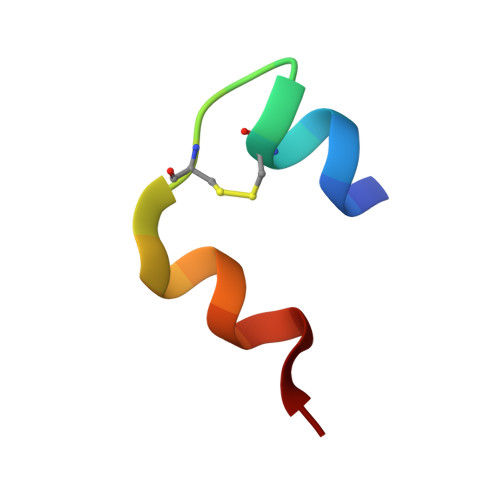
MoleculeChains  Sequence LengthOrganismDetailsImage
InsulinA [auth G],
C [auth I]
21Homo sapiensMutation(s): 0 
Gene Names: INS
UniProt & NIH Common Fund Data Resources
Find proteins for P01308 (Homo sapiens)
Explore P01308 
Go to UniProtKB:  P01308
PHAROS:  P01308
GTEx:  ENSG00000254647 
Entity Groups
Sequence Clusters30% Identity50% Identity70% Identity90% Identity95% Identity100% Identity
UniProt GroupP01308
Sequence Annotations
Expand
Reference Sequence
Find similar proteins by:|  3D Structure
Entity ID: 2
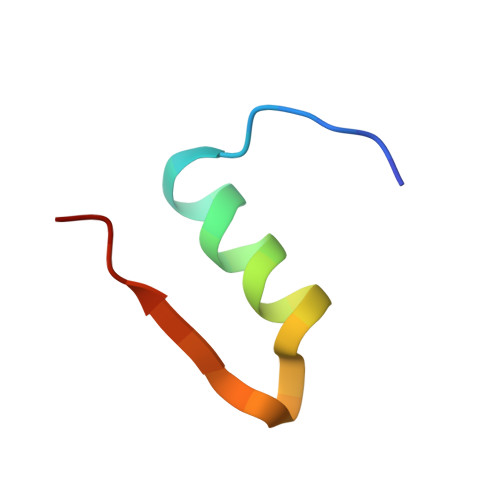
MoleculeChains  Sequence LengthOrganismDetailsImage
Insulin
B, D
30Homo sapiensMutation(s): 2 
Gene Names: INS
UniProt & NIH Common Fund Data Resources
Find proteins for P01308 (Homo sapiens)
Explore P01308 
Go to UniProtKB:  P01308
PHAROS:  P01308
GTEx:  ENSG00000254647 
Entity Groups
Sequence Clusters30% Identity50% Identity70% Identity90% Identity95% Identity100% Identity
UniProt GroupP01308
Sequence Annotations
Expand
Reference Sequence

Experimental Data & Validation

Experimental Data

  • Method: X-RAY DIFFRACTION
  • Resolution: 1.26 Å
  • R-Value Free:  0.152 (Depositor), 0.152 (DCC) 
  • R-Value Work:  0.128 (Depositor), 0.133 (DCC) 
  • R-Value Observed: 0.129 (Depositor) 
Space Group: H 3
Unit Cell:
Length ( Å )Angle ( ˚ )
a = 82.44α = 90
b = 82.44β = 90
c = 33.65γ = 120
Software Package:
Software NamePurpose
PHENIXrefinement
MOSFLMdata reduction
SCALAdata scaling
PHASERphasing

Structure Validation

View Full Validation Report


Entry History 

Deposition Data

Revision History  (Full details and data files)

  • Version 1.0: 2019-07-03
    Type: Initial release
  • Version 1.1: 2021-02-10
    Changes: Database references, Derived calculations
  • Version 1.2: 2024-01-17
    Changes: Data collection, Database references, Refinement description, Source and taxonomy
  • Version 1.3: 2024-11-06
    Changes: Structure summary