6TKK | pdb_00006tkk

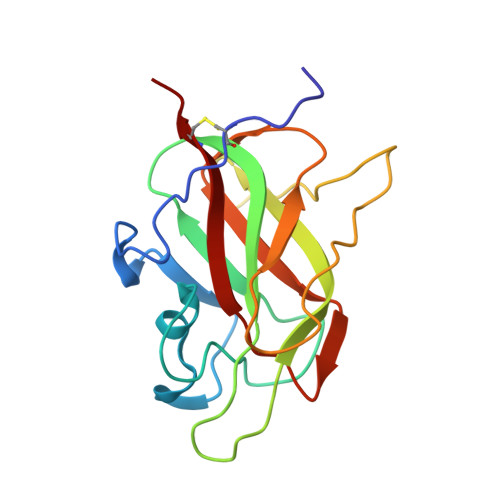
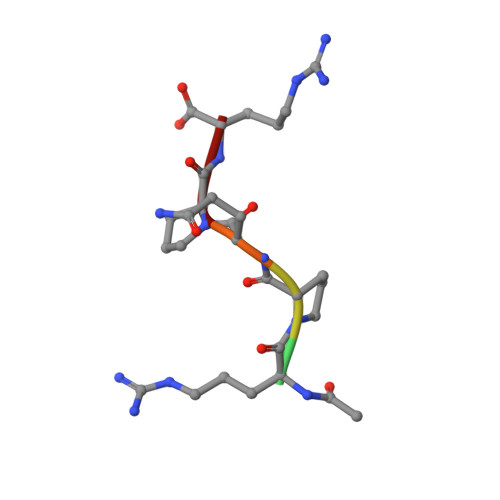
Neuropilin 1-b1 domain in a complex with the C-terminal VEGFB186 peptide


Experimental Data Snapshot

  • Method: X-RAY DIFFRACTION
  • Resolution: 1.06 Å
  • R-Value Free: 
    0.149 (Depositor), 0.150 (DCC) 
  • R-Value Work: 
    0.136 (Depositor), 0.140 (DCC) 
  • R-Value Observed: 
    0.137 (Depositor) 

Starting Model: experimental
View more details

wwPDB Validation   3D Report Full Report


This is version 1.3 of the entry. See complete history


Literature

VEGFA, B, C: Implications of the C-Terminal Sequence Variations for the Interaction with Neuropilins.

Eldrid, C.Zloh, M.Fotinou, C.Yelland, T.Yu, L.Mota, F.Selwood, D.L.Djordjevic, S.

(2022) Biomolecules 12

  • DOI: https://doi.org/10.3390/biom12030372
  • Primary Citation of Related Structures:  
    6TDB, 6TJT, 6TKK

  • PubMed Abstract: 

    Vascular endothelial growth factors (VEGFs) are the key regulators of blood and lymphatic vessels' formation and function. Each of the proteins from the homologous family VEGFA, VEGFB, VEGFC and VEGFD employs a core cysteine-knot structural domain for the specific interaction with one or more of the cognate tyrosine kinase receptors. Additional diversity is exhibited by the involvement of neuropilins-transmembrane co-receptors, whose b1 domain contains the binding site for the C-terminal sequence of VEGFs. Although all relevant isoforms of VEGFs that interact with neuropilins contain the required C-terminal Arg residue, there is selectivity of neuropilins and VEGF receptors for the VEGF proteins, which is reflected in the physiological roles that they mediate. To decipher the contribution made by the C-terminal sequences of the individual VEGF proteins to that functional differentiation, we determined structures of molecular complexes of neuropilins and VEGF-derived peptides and examined binding interactions for all neuropilin-VEGF pairs experimentally and computationally. While X-ray crystal structures and ligand-binding experiments highlighted similarities between the ligands, the molecular dynamics simulations uncovered conformational preferences of VEGF-derived peptides beyond the C-terminal arginine that contribute to the ligand selectivity of neuropilins. The implications for the design of the selective antagonists of neuropilins' functions are discussed.


  • Organizational Affiliation
    • Structural and Molecular Biology, ISMB, Division of Biosciences, University College London, Gower Street, London WC1E 6BT, UK.

Macromolecules
Find similar proteins by:  (by identity cutoff)  |  3D Structure
Entity ID: 1
MoleculeChains Sequence LengthOrganismDetailsImage
Neuropilin-1158Homo sapiensMutation(s): 0 
Gene Names: NRP1NRPVEGF165R
UniProt & NIH Common Fund Data Resources
Find proteins for O14786 (Homo sapiens)
Explore O14786 
Go to UniProtKB:  O14786
PHAROS:  O14786
GTEx:  ENSG00000099250 
Entity Groups  
Sequence Clusters30% Identity50% Identity70% Identity90% Identity95% Identity100% Identity
UniProt GroupO14786
Sequence Annotations
Expand
  • Reference Sequence

Find similar proteins by:  Sequence   |   3D Structure  

Entity ID: 2
MoleculeChains Sequence LengthOrganismDetailsImage
ACE-ARG-PRO-GLN-PRO-ARG6Homo sapiensMutation(s): 0 
UniProt & NIH Common Fund Data Resources
Find proteins for P49765 (Homo sapiens)
Explore P49765 
Go to UniProtKB:  P49765
PHAROS:  P49765
GTEx:  ENSG00000173511 
Entity Groups  
UniProt GroupP49765
Sequence Annotations
Expand
  • Reference Sequence
Experimental Data & Validation

Experimental Data

  • Method: X-RAY DIFFRACTION
  • Resolution: 1.06 Å
  • R-Value Free:  0.149 (Depositor), 0.150 (DCC) 
  • R-Value Work:  0.136 (Depositor), 0.140 (DCC) 
  • R-Value Observed: 0.137 (Depositor) 
Space Group: P 21 21 21
Unit Cell:
Length ( Å )Angle ( ˚ )
a = 38.88α = 90
b = 39.98β = 90
c = 97.61γ = 90
Software Package:
Software NamePurpose
REFMACrefinement
PHENIXrefinement
xia2data reduction
Aimlessdata scaling
PHASERphasing

Structure Validation

View Full Validation Report


Entry History 

Deposition Data

Revision History  (Full details and data files)

  • Version 1.0: 2020-12-16
    Type: Initial release
  • Version 1.1: 2024-01-24
    Changes: Data collection, Database references, Refinement description
  • Version 1.2: 2024-11-13
    Changes: Structure summary
  • Version 1.3: 2026-03-25
    Changes: Database references