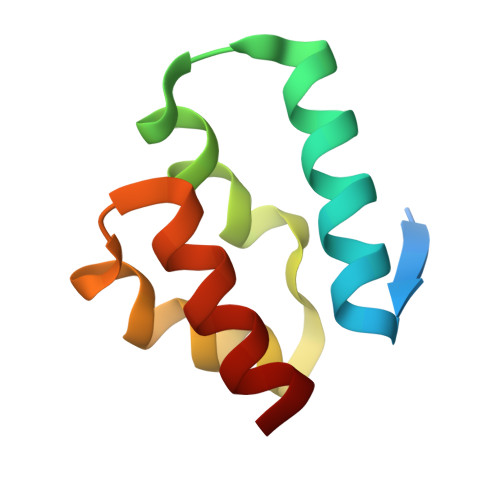
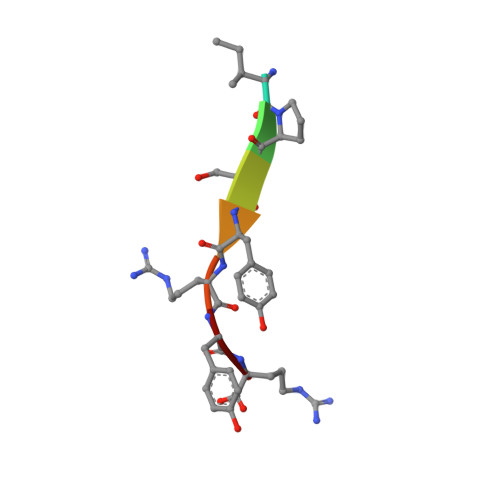
6TNO | pdb_00006tno

Crystal structure of the human Arc N-lobe bound to stargazin


Experimental Data Snapshot

  • Method: X-RAY DIFFRACTION
  • Resolution: 1.90 Å
  • R-Value Free: 
    0.216 (Depositor), 0.219 (DCC) 
  • R-Value Work: 
    0.182 (Depositor), 0.184 (DCC) 

Starting Model: experimental
View more details

wwPDB Validation 3D Report Full Report

Validation slider image for 6TNO

This is version 1.2 of the entry. See complete history

Literature

Structural properties and peptide ligand binding of the capsid homology domains of human Arc.

Hallin, E.I.Bramham, C.R.Kursula, P.

(2021) Biochem Biophys Rep 26: 100975-100975

  • DOI: https://doi.org/10.1016/j.bbrep.2021.100975
  • Primary Citation Related Structures: 
    6TN7, 6TNO, 6TNQ, 6TQ0

  • PubMed Abstract: 

    The activity-regulated cytoskeleton-associated protein (Arc) is important for synaptic plasticity and the normal function of the brain. Arc interacts with neuronal postsynaptic proteins, but the mechanistic details of its function have not been fully established. The C-terminal domain of Arc consists of tandem domains, termed the N- and C-lobe. The N-lobe harbours a peptide binding site, able to bind multiple targets. By measuring the affinity of human Arc towards various peptides from stargazin and guanylate kinase-associated protein (GKAP), we have refined its specificity determinants. We found two sites in the GKAP repeat region that bind to Arc and confirmed these interactions by X-ray crystallography. Phosphorylation of the stargazin peptide did not affect binding affinity but caused changes in thermodynamic parameters. Comparison of the crystal structures of three high-resolution human Arc-peptide complexes identifies three conserved C-H…π interactions at the binding cavity, explaining the sequence specificity of short linear motif binding by Arc. We further characterise central residues of the Arc lobe fold, show the effects of peptide binding on protein dynamics, and identify acyl carrier proteins as structures similar to the Arc lobes. We hypothesise that Arc may affect protein-protein interactions and phase separation at the postsynaptic density, affecting protein turnover and re-modelling of the synapse. The present data on Arc structure and ligand binding will help in further deciphering these processes.


  • Organizational Affiliation
    • Department of Biomedicine, University of Bergen, Norway.

Macromolecule Content 

  • Total Structure Weight: 29.93 kDa 
  • Atom Count: 2,083 
  • Modeled Residue Count: 223 
  • Deposited Residue Count: 249 
  • Unique protein chains: 2

Macromolecules

Find similar proteins by:|  3D Structure
Entity ID: 1
MoleculeChains  Sequence LengthOrganismDetailsImage
Arc_C domain-containing protein
A, C, E
75Felis catusMutation(s): 0 
Gene Names: ARC
Find similar proteins by:  Sequence   |   3D Structure  
Entity ID: 2
MoleculeChains  Sequence LengthOrganismDetailsImage
Chains: B,D,F
B, D, F
8Homo sapiensMutation(s): 0 
UniProt & NIH Common Fund Data Resources
Find proteins for Q9Y698 (Homo sapiens)
Explore Q9Y698 
Go to UniProtKB:  Q9Y698
PHAROS:  Q9Y698
GTEx:  ENSG00000166862 
Entity Groups
UniProt GroupQ9Y698
Sequence Annotations
Expand
Reference Sequence

Experimental Data & Validation

Experimental Data

  • Method: X-RAY DIFFRACTION
  • Resolution: 1.90 Å
  • R-Value Free:  0.216 (Depositor), 0.219 (DCC) 
  • R-Value Work:  0.182 (Depositor), 0.184 (DCC) 
Space Group: P 1 21 1
Unit Cell:
Length ( Å )Angle ( ˚ )
a = 51.39α = 90
b = 29.77β = 92.51
c = 71.79γ = 90
Software Package:
Software NamePurpose
PHENIXrefinement
XDSdata reduction
XDSdata scaling
PHASERphasing

Structure Validation

View Full Validation Report


Entry History 

& Funding Information

Deposition Data


Funding OrganizationLocationGrant Number
Norwegian Research CouncilNorway249951

Revision History  (Full details and data files)

  • Version 1.0: 2020-12-16
    Type: Initial release
  • Version 1.1: 2021-04-07
    Changes: Database references
  • Version 1.2: 2024-01-24
    Changes: Data collection, Database references, Refinement description