7VPY | pdb_00007vpy

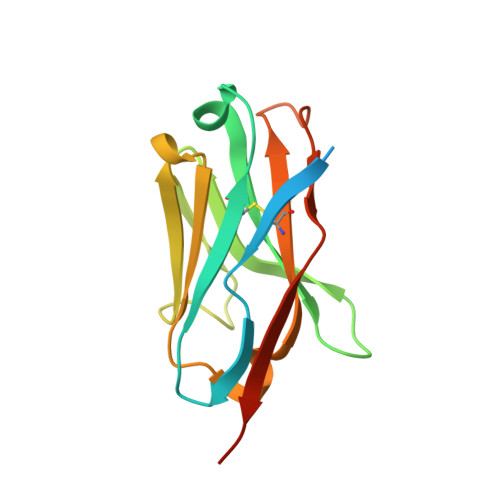
Crystal structure of the neutralizing nanobody P86 against SARS-CoV-2


Experimental Data Snapshot

  • Method: X-RAY DIFFRACTION
  • Resolution: 1.60 Å
  • R-Value Free: 
    0.213 (Depositor), 0.214 (DCC) 
  • R-Value Work: 
    0.177 (Depositor), 0.177 (DCC) 
  • R-Value Observed: 
    0.179 (Depositor) 

Starting Model: experimental
View more details

wwPDB Validation 3D Report Full Report

Validation slider image for 7VPY

This is version 1.2 of the entry. See complete history

Literature

A panel of nanobodies recognizing conserved hidden clefts of all SARS-CoV-2 spike variants including Omicron.

Maeda, R.Fujita, J.Konishi, Y.Kazuma, Y.Yamazaki, H.Anzai, I.Watanabe, T.Yamaguchi, K.Kasai, K.Nagata, K.Yamaoka, Y.Miyakawa, K.Ryo, A.Shirakawa, K.Sato, K.Makino, F.Matsuura, Y.Inoue, T.Imura, A.Namba, K.Takaori-Kondo, A.

(2022) Commun Biol 5: 669-669

  • DOI: https://doi.org/10.1038/s42003-022-03630-3
  • Primary Citation Related Structures: 
    7VPY, 7VQ0

  • PubMed Abstract: 

    We are amid the historic coronavirus infectious disease 2019 (COVID-19) pandemic. Imbalances in the accessibility of vaccines, medicines, and diagnostics among countries, regions, and populations, and those in war crises, have been problematic. Nanobodies are small, stable, customizable, and inexpensive to produce. Herein, we present a panel of nanobodies that can detect the spike proteins of five SARS-CoV-2 variants of concern (VOCs) including Omicron. Here we show via ELISA, lateral flow, kinetic, flow cytometric, microscopy, and Western blotting assays that our nanobodies can quantify the spike variants. This panel of nanobodies broadly neutralizes viral infection caused by pseudotyped and authentic SARS-CoV-2 VOCs. Structural analyses show that the P86 clone targets epitopes that are conserved yet unclassified on the receptor-binding domain (RBD) and contacts the N-terminal domain (NTD). Human antibodies rarely access both regions; consequently, the clone buries hidden crevasses of SARS-CoV-2 spike proteins that go undetected by conventional antibodies.


  • Organizational Affiliation
    • Department of Haematology and Oncology, Graduate School of Medicine, Kyoto University, Kyoto, 606-8507, Japan. maeda@cognano.co.jp.

Macromolecule Content 

  • Total Structure Weight: 32.22 kDa 
  • Atom Count: 2,167 
  • Modeled Residue Count: 232 
  • Deposited Residue Count: 288 
  • Unique protein chains: 1

Macromolecules

Find similar proteins by:|  3D Structure
Entity ID: 1
MoleculeChains  Sequence LengthOrganismDetailsImage
Nanobody
A, B
144Vicugna pacosMutation(s): 0 

Small Molecules

Ligands 2 Unique
IDChains Name / Formula / InChI Key2D Diagram3D Interactions
SO4

Query on SO4


Download:Ideal Coordinates CCD File
C [auth A]
D [auth A]
E [auth A]
F [auth A]
G [auth A]
C [auth A],
D [auth A],
E [auth A],
F [auth A],
G [auth A],
I [auth B],
J [auth B],
K [auth B],
L [auth B]
SULFATE ION
O4 S
QAOWNCQODCNURD-UHFFFAOYSA-L
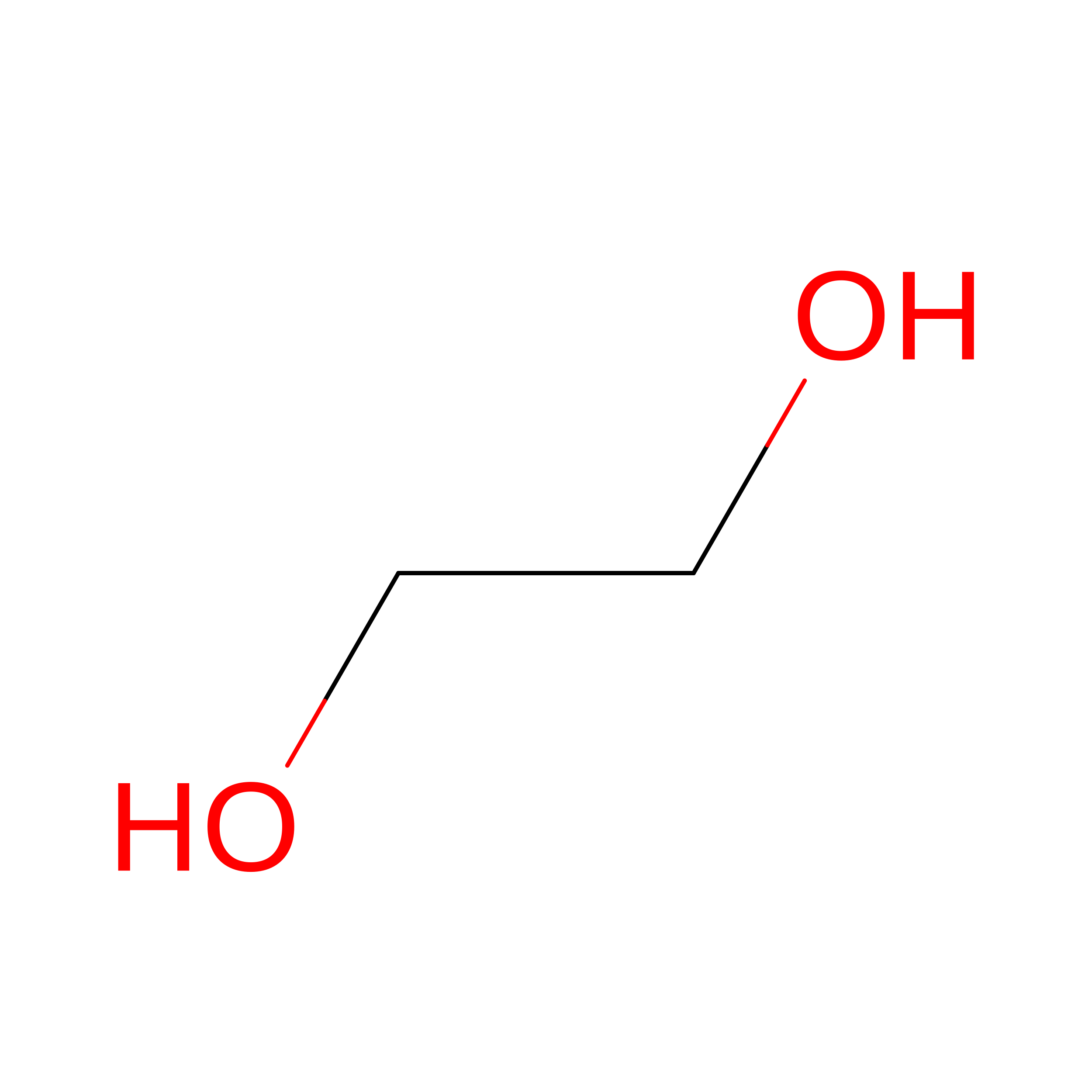
EDO

Query on EDO


Download:Ideal Coordinates CCD File
H [auth B]1,2-ETHANEDIOL
C2 H6 O2
LYCAIKOWRPUZTN-UHFFFAOYSA-N

Experimental Data & Validation

Experimental Data

  • Method: X-RAY DIFFRACTION
  • Resolution: 1.60 Å
  • R-Value Free:  0.213 (Depositor), 0.214 (DCC) 
  • R-Value Work:  0.177 (Depositor), 0.177 (DCC) 
  • R-Value Observed: 0.179 (Depositor) 
Space Group: C 1 2 1
Unit Cell:
Length ( Å )Angle ( ˚ )
a = 105.078α = 90
b = 43.166β = 110.758
c = 56.027γ = 90
Software Package:
Software NamePurpose
PHENIXrefinement
XDSdata reduction
Aimlessdata scaling
MOLREPphasing

Structure Validation

View Full Validation Report


Entry History 

& Funding Information

Deposition Data


Funding OrganizationLocationGrant Number
Japan Agency for Medical Research and Development (AMED)Japan20fk0108268
Japan Agency for Medical Research and Development (AMED)Japan20fk018517
Japan Agency for Medical Research and Development (AMED)Japan20fk018413
Japan Science and TechnologyJapan--
Japan Society for the Promotion of Science (JSPS)Japan--

Revision History  (Full details and data files)

  • Version 1.0: 2022-07-20
    Type: Initial release
  • Version 1.1: 2023-11-29
    Changes: Data collection, Refinement description
  • Version 1.2: 2024-10-30
    Changes: Structure summary