8F7T | pdb_00008f7t

Glycan-Base ConC Env Trimer


Experimental Data Snapshot

  • Method: ELECTRON MICROSCOPY
  • Resolution: 4.10 Å
  • Aggregation State: PARTICLE 
  • Reconstruction Method: SINGLE PARTICLE 

wwPDB Validation 3D Report Full Report

Validation slider image for 8F7T

This is version 1.2 of the entry. See complete history

Literature

Soluble prefusion-closed HIV-envelope trimers with glycan-covered bases.

Olia, A.S.Cheng, C.Zhou, T.Biju, A.Harris, D.R.Changela, A.Duan, H.Ivleva, V.B.Kong, W.P.Ou, L.Rawi, R.Tsybovsky, Y.Van Wazer, D.J.Corrigan, A.R.Gonelli, C.A.Lee, M.McKee, K.Narpala, S.O'Dell, S.Parchment, D.K.Stancofski, E.D.Stephens, T.Tan, I.Teng, I.T.Wang, S.Wei, Q.Yang, Y.Yang, Z.Zhang, B.Novak, J.Renfrow, M.B.Doria-Rose, N.A.Koup, R.A.McDermott, A.B.Gall, J.G.Lei, Q.P.Mascola, J.R.Kwong, P.D.

(2023) iScience 26: 107403-107403

  • DOI: https://doi.org/10.1016/j.isci.2023.107403
  • Primary Citation Related Structures: 
    8F7T

  • PubMed Abstract: 

    Soluble HIV-1-envelope (Env) trimers elicit immune responses that target their solvent-exposed protein bases, the result of removing these trimers from their native membrane-bound context. To assess whether glycosylation could limit these base responses, we introduced sequons encoding potential N -linked glycosylation sites (PNGSs) into base-proximal regions. Expression and antigenic analyses indicated trimers bearing six-introduced PNGSs to have reduced base recognition. Cryo-EM analysis revealed trimers with introduced PNGSs to be prone to disassembly and introduced PNGS to be disordered. Protein-base and glycan-base trimers induced reciprocally symmetric ELISA responses, in which only a small fraction of the antibody response to glycan-base trimers recognized protein-base trimers and vice versa. EM polyclonal epitope mapping revealed glycan-base trimers -even those that were stable biochemically- to elicit antibodies that recognized disassembled trimers. Introduced glycans can thus mask the protein base but their introduction may yield neo-epitopes that dominate the immune response.


  • Organizational Affiliation
    • Vaccine Research Center, National Institutes of Health, Bethesda, MD 20892, USA.

Macromolecule Content 

  • Total Structure Weight: 220.72 kDa 
  • Atom Count: 13,326 
  • Modeled Residue Count: 1,641 
  • Deposited Residue Count: 1,905 
  • Unique protein chains: 2

Macromolecules

Find similar proteins by:|  3D Structure
Entity ID: 1
MoleculeChains  Sequence LengthOrganismDetailsImage
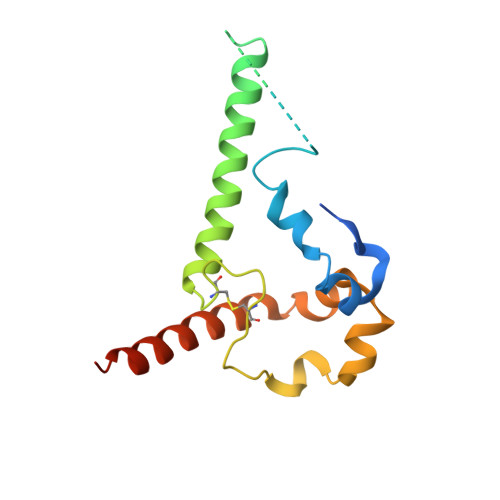
HIV-1 Env gp41
A, B, D
156Human immunodeficiency virus 1Mutation(s): 0 
Find similar proteins by:|  3D Structure
Entity ID: 2
MoleculeChains  Sequence LengthOrganismDetailsImage
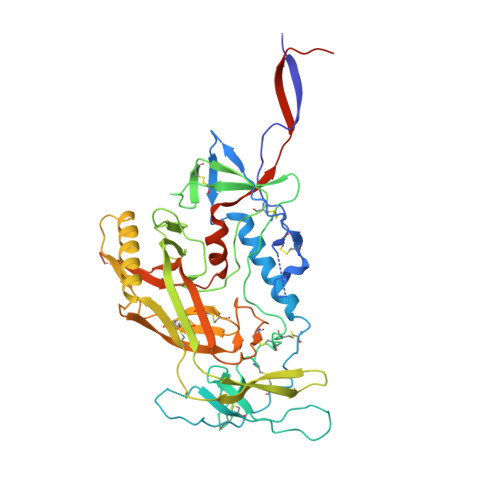
HIV-1 Env gp120C,
E,
F [auth G]
479Human immunodeficiency virus 1Mutation(s): 0 

Oligosaccharides

Help  
Entity ID: 3
MoleculeChains Length2D Diagram GlycosylationD Interactions
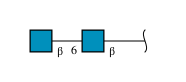
2-acetamido-2-deoxy-beta-D-glucopyranose-(1-6)-2-acetamido-2-deoxy-beta-D-glucopyranoseG [auth I],
H [auth K],
I [auth L]
2N-Glycosylation
Glycosylation Resources
GlyTouCan: G35932AR
GlyCosmos: G35932AR
GlyGen: G35932AR

Small Molecules

Ligands 1 Unique
IDChains Name / Formula / InChI Key2D Diagram3D Interactions
NAG

Query on NAG


Download:Ideal Coordinates CCD File
J [auth A]
K [auth B]
L [auth C]
M [auth C]
N [auth C]
J [auth A],
K [auth B],
L [auth C],
M [auth C],
N [auth C],
O [auth C],
P [auth D],
Q [auth E],
R [auth E],
S [auth E],
T [auth E],
U [auth G],
V [auth G],
W [auth G],
X [auth G]
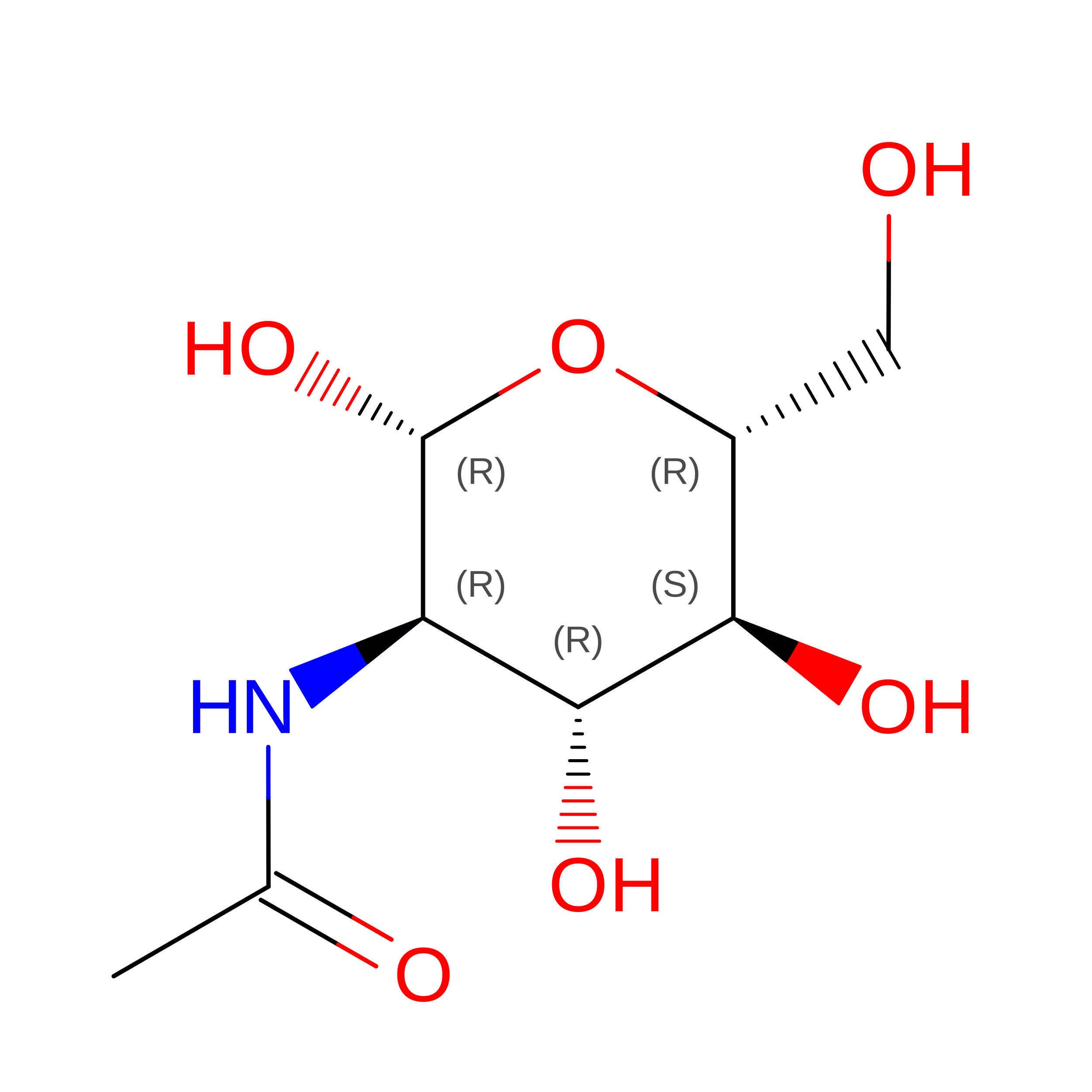
2-acetamido-2-deoxy-beta-D-glucopyranose
C8 H15 N O6
OVRNDRQMDRJTHS-FMDGEEDCSA-N

Experimental Data & Validation

Experimental Data

  • Method: ELECTRON MICROSCOPY
  • Resolution: 4.10 Å
  • Aggregation State: PARTICLE 
  • Reconstruction Method: SINGLE PARTICLE 
EM Software:
TaskSoftware PackageVersion
MODEL REFINEMENTPHENIX

Structure Validation

View Full Validation Report


Entry History 

& Funding Information

Deposition Data


Funding OrganizationLocationGrant Number
National Institutes of Health/National Institute Of Allergy and Infectious Diseases (NIH/NIAID)United States--

Revision History  (Full details and data files)

  • Version 1.0: 2023-09-27
    Type: Initial release
  • Version 1.1: 2024-11-20
    Changes: Data collection, Structure summary
  • Version 1.2: 2025-05-21
    Changes: Data collection