Download Mendeley
Structural basis and biased signaling of proton sensation by GPCRs mediated by extracellular histidine rearrangement.
Guo, L., Zhu, K., Zhong, Y.N., Gao, M., Liu, J., Qi, Z., Liu, Z., Rong, N., Zhang, M., Li, D., Zhang, Q., Yang, G., Zhang, X., Zhang, M., Ding, N., Ping, Y.Q., Yang, Z., Xiao, P., Xia, M., Yu, X., Gaole, A., Sun, J.P., Yang, F.(2025) Mol Cell 85: 1658-1673.e7
- PubMed: 40215959 Search on PubMed
- DOI: https://doi.org/10.1016/j.molcel.2025.03.018
- Primary Citation Related Structures:
8Z3Y - PubMed Abstract:
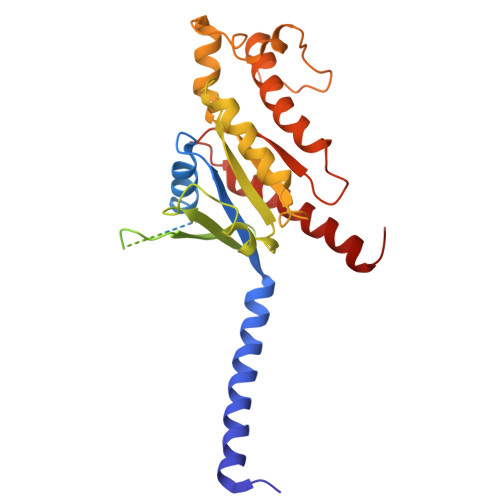
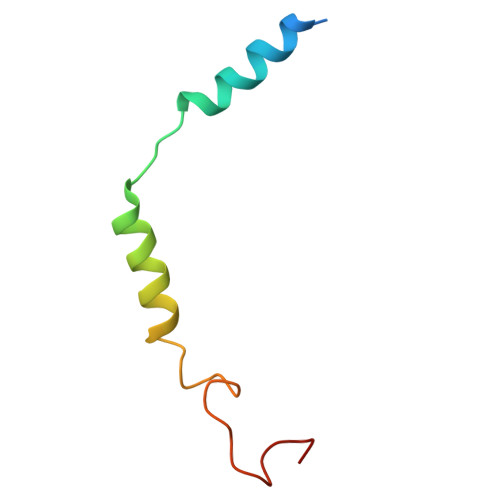
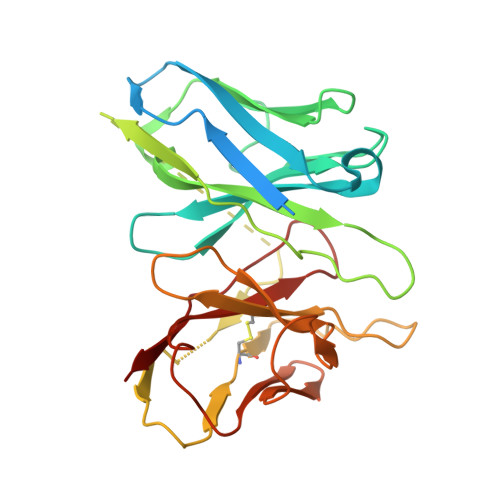
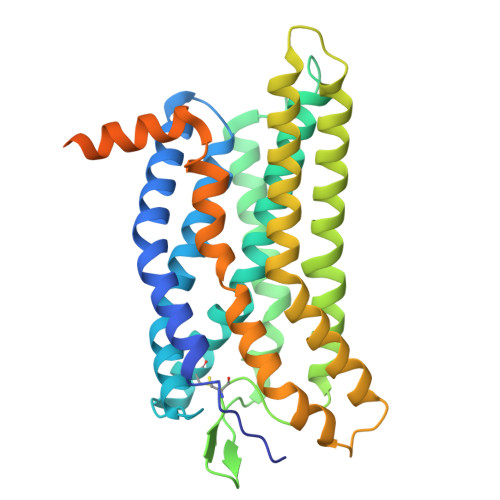
Proton sensing by G protein-coupled receptors (GPCRs) is crucial in many life activities. However, its underlying mechanism remains unclear. Here, we report 8 cryoelectron microscopy (cryo-EM) structures of human GPR4 and GPR68 at different pH values and in complex with Gs or Gq trimers or in apo state. Structural inspection, structure-based pKa calculations, and mutational and computational analyses revealed that protonation of two conserved extracellular histidines induced polar network formation and other conformational changes to tether 7-transmembrane (TM7) to second extracellular loop (ECL2), and these changes constitute the central mechanisms of proton-induced activation of GPR4 and GPR68. Unexpectedly, proton sensation by specific extracellular histidine determined biased G protein coupling of GPR4. Moreover, GPR68's additional pH-sensing H84 2.67 enhances its function in a more acidic optimal pH range. The propagation path connecting proton-sensing histidines to the toggle switch was characterized. Collectively, we provide structural insights into the proton sensing, activation, and downstream effector coupling mechanisms of proton-sensing GPCRs.
- Advanced Medical Research Institute, Cheeloo College of Medicine, The Second Hospital Shandong University, Jinan, China.
Organizational Affiliation: