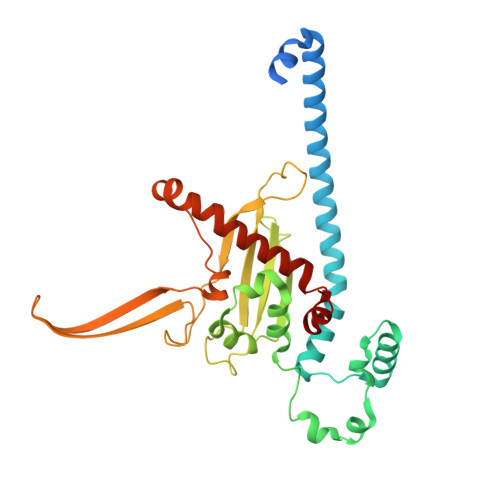
9B23 | pdb_00009b23

Cryo-EM structure of Nap1 core

  • Classification: CHAPERONE
  • Organism(s): Saccharomyces cerevisiae
  • Expression System: Escherichia coli
  • Mutation(s): No 

  • Deposited: 2024-03-14 Released: 2024-11-27 
  • Deposition Author(s): Jiou, J., Fung, H.Y.J., Chook, Y.M.
  • Funding Organization(s): National Institutes of Health/National Institute of General Medical Sciences (NIH/NIGMS), Welch Foundation, Cancer Prevention and Research Institute of Texas (CPRIT)

Experimental Data Snapshot

  • Method: ELECTRON MICROSCOPY
  • Resolution: 3.20 Å
  • Aggregation State: PARTICLE 
  • Reconstruction Method: SINGLE PARTICLE 

Starting Model: in silico
View more details

wwPDB Validation   3D Report Full Report


This is version 1.1 of the entry. See complete history


Literature

Nap1 and Kap114 co-chaperone H2A-H2B and facilitate targeted histone release in the nucleus.

Fung, H.Y.J.Jiou, J.Niesman, A.B.Bernardes, N.E.Chook, Y.M.

(2025) J Cell Biol 224

  • DOI: https://doi.org/10.1083/jcb.202408193
  • Primary Citation of Related Structures:  
    9B23, 9B31, 9B3F, 9B3I

  • PubMed Abstract: 

    Core histones, synthesized and processed in the cytoplasm, must be chaperoned as they are transported into the nucleus for nucleosome assembly. The importin Kap114 transports H2A-H2B into the yeast nucleus, where RanGTP facilitates histone release. Kap114 and H2A-H2B also bind the histone chaperone Nap1, but how Nap1 and Kap114 cooperate in transport and nucleosome assembly remains unclear. Here, biochemical and structural analyses show that Kap114, H2A-H2B, and a Nap1 dimer (Nap12) associate in the absence and presence of RanGTP to form equimolar complexes. A previous study had shown that RanGTP reduces Kap114's ability to chaperone H2A-H2B, but a new cryo-EM structure of the Nap12•H2A-H2B•Kap114•RanGTP complex explains how both Kap114 and Nap12 interact with H2A-H2B, restoring its chaperoning within the assembly while effectively depositing it into nucleosomes. Together, our results suggest that Kap114 and Nap12 provide a sheltered path that facilitates the transfer of H2A-H2B from Kap114 to Nap12, ultimately directing its specific deposition into nucleosomes.


  • Organizational Affiliation
    • Department of Pharmacology, University of Texas Southwestern Medical Center, Dallas, TX, USA.

Macromolecules
Find similar proteins by:  (by identity cutoff)  |  3D Structure
Entity ID: 1
MoleculeChains Sequence LengthOrganismDetailsImage
NAP1 isoform 1A [auth D],
B [auth E]
313Saccharomyces cerevisiaeMutation(s): 0 
Gene Names: NAP1GI527_G0003692
UniProt
Find proteins for P25293 (Saccharomyces cerevisiae (strain ATCC 204508 / S288c))
Explore P25293 
Go to UniProtKB:  P25293
Entity Groups  
Sequence Clusters30% Identity50% Identity70% Identity90% Identity95% Identity100% Identity
UniProt GroupP25293
Sequence Annotations
Expand
  • Reference Sequence
Experimental Data & Validation

Experimental Data

  • Method: ELECTRON MICROSCOPY
  • Resolution: 3.20 Å
  • Aggregation State: PARTICLE 
  • Reconstruction Method: SINGLE PARTICLE 
EM Software:
TaskSoftware PackageVersion
RECONSTRUCTIONcryoSPARC
MODEL REFINEMENTPHENIX1.19.1_4122:

Structure Validation

View Full Validation Report


Entry History & Funding Information

Deposition Data


Funding OrganizationLocationGrant Number
National Institutes of Health/National Institute of General Medical Sciences (NIH/NIGMS)United StatesR35GM141461
National Institutes of Health/National Institute of General Medical Sciences (NIH/NIGMS)United StatesR01GM069909
National Institutes of Health/National Institute of General Medical Sciences (NIH/NIGMS)United StatesT32GM008203
Welch FoundationUnited StatesI-1532
Cancer Prevention and Research Institute of Texas (CPRIT)United StatesRP220582

Revision History  (Full details and data files)

  • Version 1.0: 2024-11-27
    Type: Initial release
  • Version 1.1: 2024-12-11
    Changes: Data collection, Database references