Download Mendeley
Mining Thermophile Genomes for New PETases with Exceptional Thermostabilities Using Sequence Similarity Networks.
Hu, Z., Klupt, K., Zechel, D.L., Jia, Z., Howe, G.(2025) Chembiochem 26: e202500065-e202500065
- PubMed: 40069109 Search on PubMedSearch on PubMed Central
- DOI: https://doi.org/10.1002/cbic.202500065
- Primary Citation Related Structures:
9EH6 - PubMed Abstract:
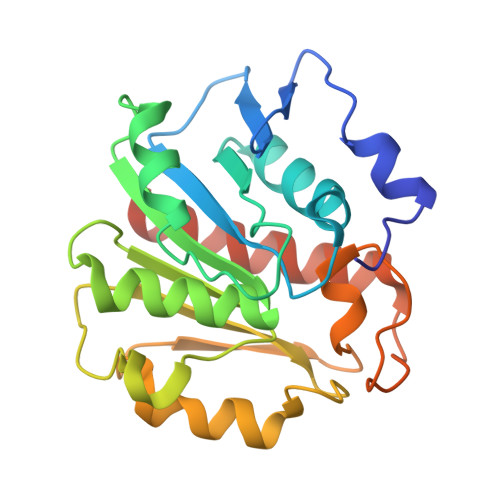
Enzymatic hydrolysis of polyethylene terephthalate (PET) is a promising technology for advancing a circular PET economy. Several PET-degrading α/β hydrolases have been identified, but the full potential of this enzyme family to catalyze PET hydrolysis remains largely unexplored. To address this, sequence similarity networks are employed to investigate the α/β hydrolase fold-5 subfamily (IPR029059) for new PETases. Priority is given to sequences from thermophiles, as thermostable enzymes are likely more suitable for industrial applications. Ten enzymes with ≈20% sequence identity to the well-known LCC-PETase are identified, and seven are successfully overexpressed and purified for in vitro characterization. Each enzyme catalyzes the hydrolysis of p-nitrophenyl butyrate, a mimic of trimeric PET, and emulsified PET nanoparticles. Notably, three enzymes are also capable of hydrolyzing PET films. Novel PETases exhibit melting temperatures (T m ) exceeding 55 °C and only modest losses of activity after incubation at 70 °C for 24 h. The crystal structure of AroC (T m = 85 °C) is resolved to 2.2 Å, revealing several salt bridges that likely confer thermostability, and a unique loop that is conserved among the PETases described here. These novel enzymes will enable engineering campaigns to generate thermostable and catalytically efficient PETases for use as industrial biocatalysts.
- Department of Chemistry, Queen's University, Kingston, ON, Canada.
Organizational Affiliation: