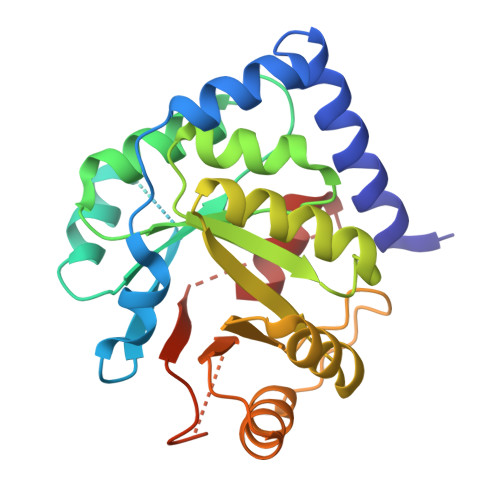
9HVB | pdb_00009hvb

High-efficiency Kemp eliminases by complete computational design


Experimental Data Snapshot

  • Method: X-RAY DIFFRACTION
  • Resolution: 2.00 Å
  • R-Value Free: 
    0.242 (Depositor), 0.242 (DCC) 
  • R-Value Work: 
    0.192 (Depositor), 0.193 (DCC) 
  • R-Value Observed: 
    0.194 (Depositor) 

Starting Model: in silico
View more details

wwPDB Validation 3D Report Full Report

Validation slider image for 9HVB

Ligand Structure Quality Assessment 


This is version 1.3 of the entry. See complete history

Literature

Complete computational design of high-efficiency Kemp elimination enzymes.

Listov, D.Vos, E.Hoffka, G.Hoch, S.Y.Berg, A.Hamer-Rogotner, S.Dym, O.Kamerlin, S.C.L.Fleishman, S.J.

(2025) Nature 643: 1421-1427

  • DOI: https://doi.org/10.1038/s41586-025-09136-2
  • Primary Citation Related Structures: 
    9HVB, 9HVG, 9HVH

  • PubMed Abstract: 

    Until now, computationally designed enzymes exhibited low catalytic rates 1-5 and required intensive experimental optimization to reach activity levels observed in comparable natural enzymes 5-9 . These results exposed limitations in design methodology and suggested critical gaps in our understanding of the fundamentals of biocatalysis 10,11 . We present a fully computational workflow for designing efficient enzymes in TIM-barrel folds using backbone fragments from natural proteins and without requiring optimization by mutant-library screening. Three Kemp eliminase designs exhibit efficiencies greater than 2,000 M -1  s -1 . The most efficient shows more than 140 mutations from any natural protein, including a novel active site. It exhibits high stability (greater than 85 °C) and remarkable catalytic efficiency (12,700 M -1  s -1 ) and rate (2.8 s -1 ), surpassing previous computational designs by two orders of magnitude 1-5 . Furthermore, designing a residue considered essential in all previous Kemp eliminase designs increases efficiency to more than 10 5  M -1  s -1 and rate to 30 s -1 , achieving catalytic parameters comparable to natural enzymes and challenging fundamental biocatalytic assumptions. By overcoming limitations in design methodology 11 , our strategy enables programming stable, high-efficiency, new-to-nature enzymes through a minimal experimental effort.


  • Organizational Affiliation
    • Department of Biomolecular Sciences, Weizmann Institute of Science, Rehovot, Israel.

Macromolecule Content 

  • Total Structure Weight: 28.37 kDa 
  • Atom Count: 1,837 
  • Modeled Residue Count: 228 
  • Deposited Residue Count: 256 
  • Unique protein chains: 1

Macromolecules

Find similar proteins by:|  3D Structure
Entity ID: 1
MoleculeChains  Sequence LengthOrganismDetailsImage
Kemp eliminase256Escherichia coliMutation(s): 0 
EC: 4.1.1.48
UniProt
Find proteins for P9WFX7 (Mycobacterium tuberculosis (strain ATCC 25618 / H37Rv))
Explore P9WFX7 
Go to UniProtKB:  P9WFX7
Entity Groups
Sequence Clusters30% Identity50% Identity70% Identity90% Identity95% Identity100% Identity
UniProt GroupP9WFX7
Sequence Annotations
Expand
Reference Sequence

Experimental Data & Validation

Experimental Data

  • Method: X-RAY DIFFRACTION
  • Resolution: 2.00 Å
  • R-Value Free:  0.242 (Depositor), 0.242 (DCC) 
  • R-Value Work:  0.192 (Depositor), 0.193 (DCC) 
  • R-Value Observed: 0.194 (Depositor) 
Space Group: P 61
Unit Cell:
Length ( Å )Angle ( ˚ )
a = 98.541α = 90
b = 98.541β = 90
c = 40.483γ = 120
Software Package:
Software NamePurpose
PHENIXrefinement
CrystalCleardata reduction
SCALEPACKdata scaling
PHASERphasing

Structure Validation

View Full Validation Report


Ligand Structure Quality Assessment 


Entry History 

& Funding Information

Deposition Data


Funding OrganizationLocationGrant Number
Volkswagen FoundationGermany94747

Revision History  (Full details and data files)

  • Version 1.0: 2025-06-11
    Type: Initial release
  • Version 1.1: 2025-06-25
    Changes: Database references
  • Version 1.2: 2025-07-02
    Changes: Database references
  • Version 1.3: 2025-08-13
    Changes: Database references