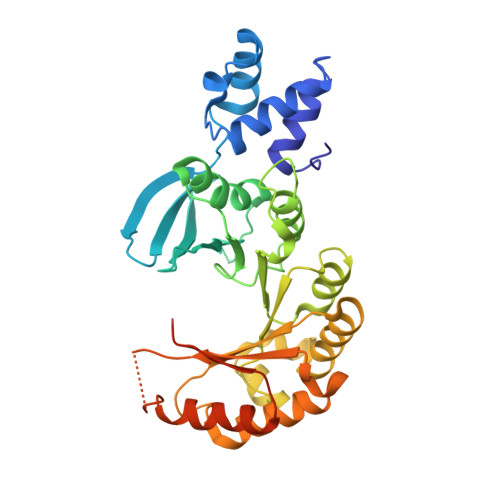
9P0P | pdb_00009p0p

Crystal structure of 23S rRNA methyltransferase Cfr, apoenzyme


Experimental Data Snapshot

  • Method: X-RAY DIFFRACTION
  • Resolution: 2.50 Å
  • R-Value Free: 
    0.309 (Depositor), 0.310 (DCC) 
  • R-Value Work: 
    0.254 (Depositor), 0.255 (DCC) 
  • R-Value Observed: 
    0.257 (Depositor) 

Starting Model: experimental
View more details

wwPDB Validation 3D Report Full Report

Validation slider image for 9P0P

This is version 1.1 of the entry. See complete history

Literature

Structural Analysis of 23S rRNA Methylating Enzyme Cfr Reveals RNA-Binding Determinants for Methylation Regiospecificity and Antibiotic Resistance.

Fruci, M.Rodriguez Hernandez, A.Skarina, T.Verellen, L.A.Tsai, K.Virta, J.M.Fujimori, D.G.Savchenko, A.Stogios, P.J.

(2026) ACS Infect Dis 12: 653-664

  • DOI: https://doi.org/10.1021/acsinfecdis.5c00828
  • Primary Citation Related Structures: 
    9P0P

  • PubMed Abstract: 

    The 23S rRNA methylating enzyme Cfr, found in pathogens including Staphylococcus aureus , Clostridium difficile , Escherichia coli , and Klebsiella pneumoniae , confers resistance to phenicols, lincosamides, oxazolidinones (including linezolid), pleuromutilins, and streptogramins A (the PhLOPS A phenotype). Cfr catalyzes methylation of the C8 position of the A2503 base in 23S rRNA, the recognition site of the above antibiotic classes. Along with the RlmN housekeeping enzyme, Cfr can also promote methylation of the C2 position of the same base. The molecular and structural basis of Cfr's dual substrate specificity is not known, which hinders our ability to design Cfr-targeting inhibitors necessary to curb PhLOPS A resistance. Here, we present the first crystal structure of Cfr and a detailed analysis of its possible interactions with rRNA. Using structure-guided mutagenesis, mass spectrometry analysis of in cellulo 23S rRNA methylated species, and in cellulo resistance studies, we identify the key amino acids essential for Cfr methylation and multidrug resistance activity. In particular, we found that Cfr's Q329 residue is important for C8-specific methylation. These data provide a framework for further studies of the biochemistry, structure, and inhibition of this important resistance determinant.


  • Organizational Affiliation
    • London Research and Development Centre, Agriculture and Agri-Food Canada, London, Ontario N5V 4T3, Canada.

Macromolecule Content 

  • Total Structure Weight: 39.91 kDa 
  • Atom Count: 2,483 
  • Modeled Residue Count: 305 
  • Deposited Residue Count: 349 
  • Unique protein chains: 1

Macromolecules

Find similar proteins by:|  3D Structure
Entity ID: 1
MoleculeChains  Sequence LengthOrganismDetailsImage
Ribosomal RNA large subunit methyltransferase Cfr349Staphylococcus aureusMutation(s): 18 
Gene Names: cfr
EC: 2.1.1.224
UniProt
Find proteins for A5HBL2 (Staphylococcus aureus)
Explore A5HBL2 
Go to UniProtKB:  A5HBL2
Entity Groups
Sequence Clusters30% Identity50% Identity70% Identity90% Identity95% Identity100% Identity
UniProt GroupA5HBL2
Sequence Annotations
Expand
Reference Sequence

Experimental Data & Validation

Experimental Data

  • Method: X-RAY DIFFRACTION
  • Resolution: 2.50 Å
  • R-Value Free:  0.309 (Depositor), 0.310 (DCC) 
  • R-Value Work:  0.254 (Depositor), 0.255 (DCC) 
  • R-Value Observed: 0.257 (Depositor) 
Space Group: P 21 21 21
Unit Cell:
Length ( Å )Angle ( ˚ )
a = 45.319α = 90
b = 58.612β = 90
c = 115.945γ = 90
Software Package:
Software NamePurpose
PHENIXrefinement
HKL-3000data reduction
HKL-3000data scaling
MrBUMPphasing
PHENIXmodel building
Cootmodel building

Structure Validation

View Full Validation Report


Entry History 

& Funding Information

Deposition Data


Funding OrganizationLocationGrant Number
National Institutes of Health/National Institute Of Allergy and Infectious Diseases (NIH/NIAID)United StatesHHSN272201700060C
National Institutes of Health/National Institute Of Allergy and Infectious Diseases (NIH/NIAID)United States75N93022C00035

Revision History  (Full details and data files)

  • Version 1.0: 2025-07-16
    Type: Initial release
  • Version 1.1: 2026-06-17
    Changes: Database references