9RI9 | pdb_00009ri9

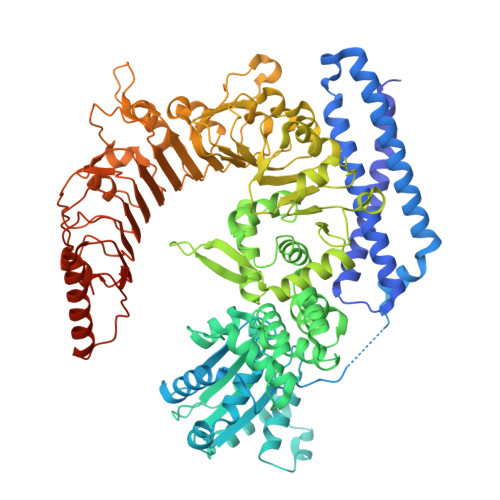
Cryo-EM structure of the tomato NRC3 hexameric resistosome


Experimental Data Snapshot

  • Method: ELECTRON MICROSCOPY
  • Resolution: 2.85 Å
  • Aggregation State: PARTICLE 
  • Reconstruction Method: SINGLE PARTICLE 

Starting Model: in silico
View more details

wwPDB Validation 3D Report Full Report

Validation slider image for 9RI9

This is version 1.2 of the entry. See complete history

Literature

A plant pathogen effector blocks stepwise assembly of a helper NLR resistosome.

Seager, B.A.Harant, A.Contreras, M.P.Hou, L.Y.Wu, C.H.Kamoun, S.Madhuprakash, J.

(2026) Sci Adv 12: eaeb1931-eaeb1931

  • DOI: https://doi.org/10.1126/sciadv.aeb1931
  • Primary Citation Related Structures: 
    9RI9, 9RIA

  • PubMed Abstract: 

    Helper NLRs function as central nodes in plant immune networks. Upon activation, they oligomerize into inflammasome-like resistosomes to initiate immune signaling, yet the dynamics of resistosome assembly remain poorly understood. Here, we show that the virulence effector AVRcap1b from the Irish potato famine pathogen Phytophthora infestans suppresses immune activation by directly engaging oligomerization intermediates of the tomato helper NLR SlNRC3. Cryo-EM structures of SlNRC3 in AVRcap1b-bound and unbound states reveal that AVRcap1b bridges multiple protomers, stabilizing a stalled intermediate and preventing formation of a functional resistosome. Leveraging AVRcap1b as a molecular tool, we also capture an additional SlNRC3 resistosome intermediate showing that assembly proceeds in a stepwise manner from dissociated monomers. These findings uncover a previously unrecognized vulnerability in NLR activation and reveal a pathogen strategy that disrupts immune complex assembly. This work advances mechanistic understanding of resistosome formation and uncovers a previously unrecognized facet of pathogen-plant coevolution.


  • Organizational Affiliation
    • The Sainsbury Laboratory, University of East Anglia, Norwich Research Park, Norwich, UK.

Macromolecule Content 

  • Total Structure Weight: 631.63 kDa 
  • Atom Count: 41,886 
  • Modeled Residue Count: 5,208 
  • Deposited Residue Count: 5,514 
  • Unique protein chains: 1

Macromolecules

Find similar proteins by:|  3D Structure
Entity ID: 1
MoleculeChains  Sequence LengthOrganismDetailsImage
NRC3919Solanum lycopersicumMutation(s): 3 
Gene Names: LOC101260638
UniProt
Find proteins for A0A3Q7GDL1 (Solanum lycopersicum)
Explore A0A3Q7GDL1 
Go to UniProtKB:  A0A3Q7GDL1
Entity Groups
Sequence Clusters30% Identity50% Identity70% Identity90% Identity95% Identity100% Identity
UniProt GroupA0A3Q7GDL1
Sequence Annotations
Expand
Reference Sequence

Experimental Data & Validation

Experimental Data

  • Method: ELECTRON MICROSCOPY
  • Resolution: 2.85 Å
  • Aggregation State: PARTICLE 
  • Reconstruction Method: SINGLE PARTICLE 
EM Software:
TaskSoftware PackageVersion
RECONSTRUCTIONcryoSPARC4.6.2
MODEL REFINEMENTPHENIX1.21.2
MODEL REFINEMENTISOLDE1.8

Structure Validation

View Full Validation Report


Entry History 

& Funding Information

Deposition Data


Funding OrganizationLocationGrant Number
Biotechnology and Biological Sciences Research Council (BBSRC)United KingdomBB/Y002997/1
Gatsby Charitable FoundationUnited Kingdom--
European Research Council (ERC)European UnionEP/Y032187/1
Biotechnology and Biological Sciences Research Council (BBSRC)United KingdomBB/V002937/1

Revision History  (Full details and data files)

  • Version 1.0: 2025-07-23
    Type: Initial release
  • Version 1.1: 2026-02-04
    Changes: Data collection, Database references, Structure summary
  • Version 1.2: 2026-06-17
    Changes: Data collection, Database references