Download Mendeley
A family of ribosome hibernation factors widespread in Archaea.
Madru, C., Bourgeois, G., Dulermo, R., Capeyrou, R., Joncour, G., Figuigui, K., Duchateau, M., Chamot-Rooke, J., Duboc, C., l'Haridon, S., Mc Teer, L., Kwapisz, M., Clouet-d'Orval, B., Bouvier, M., Mechulam, Y., Borrel, G., Schmitt, E., Flament, D.(2026) Nat Commun 17
- PubMed: 42045235 Search on PubMed
- DOI: https://doi.org/10.1038/s41467-026-72341-8
- Primary Citation Related Structures:
9SR9, 9SRA, 9SRB, 9SRC, 9SRD, 9SRE, 9SRF, 9T7H - PubMed Abstract:
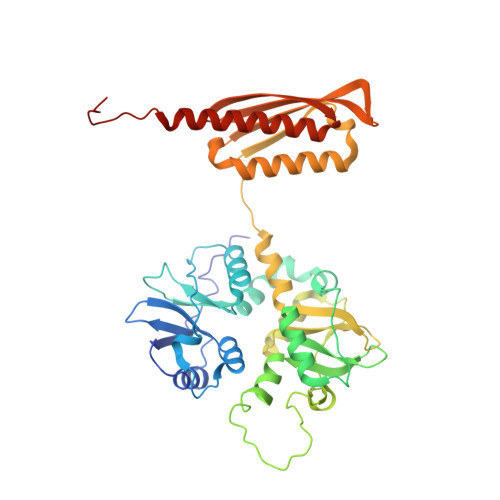
Ribosome hibernation preserves translation machinery during stress, yet its mechanisms in Archaea remain poorly defined. Using cryo-EM analysis, we studied hibernation pathways in Pyrococcus abyssi stressed cells. We identified HibA, a previously unrecognized family of hibernation factors widespread in Archaea. HibA consists of a bacterial-like HPF/RaiA domain fused to a Cystathionine Beta Synthase module. Unexpectedly, HibA binds to the ribosome in three different conformations, occupying the A, P and E sites of tRNAs, as well as that of mRNA, enhancing its ability to protect the ribosome from degradation. Idle ribosomes also frequently accumulate the archaeal homolog of eukaryotic ribosome maturation protein SBDS (aSBDS), suggesting that stressed archaeal cells may engage parallel hibernation routes in which aSBDS can complement HibA. Deletion of hibA in Thermococcus barophilus delays recovery from stationary phase and reduces 70S ribosome pools, establishing its role in ribosome preservation. Taxonomic profiling shows that many archaeal lineages encode distinct repertoires of ribosome-associated protection factors, underscoring the modular and multi-layered nature of archaeal hibernation systems. In addition, a comprehensive phylogenetic analysis highlights the evolutionary relationships between prevalent ribosome hibernation factors across Bacteria and Archaea.
- Structural Biology of the Cell, BIOC, CNRS, Ecole Polytechnique, Institut Polytechnique de Paris, 91120, Palaiseau, France.
Organizational Affiliation: