1SHL | pdb_00001shl

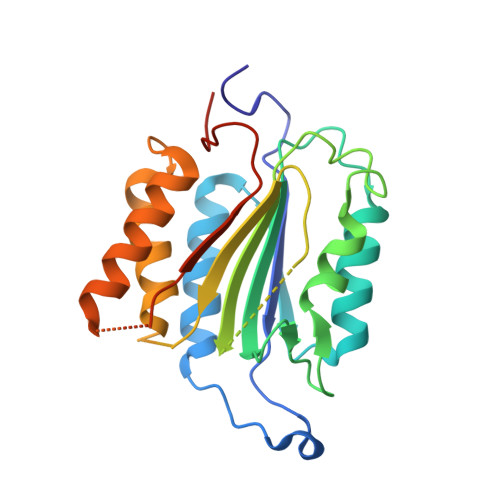
CASPASE-7 IN COMPLEX WITH FICA ALLOSTERIC INHIBITOR


Experimental Data Snapshot

  • Method: X-RAY DIFFRACTION
  • Resolution: 3.00 Å
  • R-Value Free: 
    0.273 (Depositor), 0.262 (DCC) 
  • R-Value Work: 
    0.221 (Depositor), 0.215 (DCC) 
  • R-Value Observed: 
    0.224 (Depositor) 

Starting Model: experimental
View more details

wwPDB Validation 3D Report Full Report

Validation slider image for 1SHL

Ligand Structure Quality Assessment 


This is version 1.6 of the entry. See complete history

Literature

Discovery of an allosteric site in the caspases

Hardy, J.A.Lam, J.Nguyen, J.T.O'Brien, T.Wells, J.A.

(2004) Proc Natl Acad Sci U S A 101: 12461-12466

  • DOI: https://doi.org/10.1073/pnas.0404781101
  • Primary Citation Related Structures: 
    1SHJ, 1SHL

  • PubMed Abstract: 

    Allosteric regulation of proteins by conformational change is a primary means of biological control. Traditionally it has been difficult to identify and characterize novel allosteric sites and ligands that freeze these conformational states. We present a site-directed approach using Tethering for trapping inhibitory small molecules at sites away from the active site by reversible disulfide bond formation. We screened a library of 10,000 thiol-containing compounds against accessible cysteines of two members of the caspase family of proteases, caspase-3 and -7. We discovered a previously unreported and conserved allosteric site in a deep cavity at the dimer interface 14 A from the active site. This site contains a natural cysteine that, when disulfide-bonded with either of two specific compounds, inactivates these proteases. The allosteric site is functionally coupled to the active site, such that binding of the compounds at the allosteric site prevents peptide binding at the active site. The x-ray crystal structures of caspase-7 bound by either compound demonstrates that they inhibit caspase-7 by trapping a zymogen-like conformation. This approach may be useful to identify new allosteric sites from natural or engineered cysteines, to study allosteric transitions in proteins, and to nucleate drug discovery efforts.


  • Organizational Affiliation
    • Sunesis Pharmaceuticals, Inc., 341 Oyster Point Boulevard, South San Francisco, CA 94080, USA.

Macromolecule Content 

  • Total Structure Weight: 56.71 kDa 
  • Atom Count: 3,196 
  • Modeled Residue Count: 398 
  • Deposited Residue Count: 490 
  • Unique protein chains: 1

Macromolecules

Find similar proteins by:|  3D Structure
Entity ID: 1
MoleculeChains  Sequence LengthOrganismDetailsImage
Caspase-7
A, B
245Homo sapiensMutation(s): 1 
Gene Names: CASP7MCH3
EC: 3.4.22 (PDB Primary Data), 3.4.22.60 (UniProt)
UniProt & NIH Common Fund Data Resources
Find proteins for P55210 (Homo sapiens)
Explore P55210 
Go to UniProtKB:  P55210
PHAROS:  P55210
GTEx:  ENSG00000165806 
Entity Groups
Sequence Clusters30% Identity50% Identity70% Identity90% Identity95% Identity100% Identity
UniProt GroupP55210
Sequence Annotations
Expand
Reference Sequence

Small Molecules

Ligands 1 Unique
IDChains Name / Formula / InChI Key2D Diagram3D Interactions
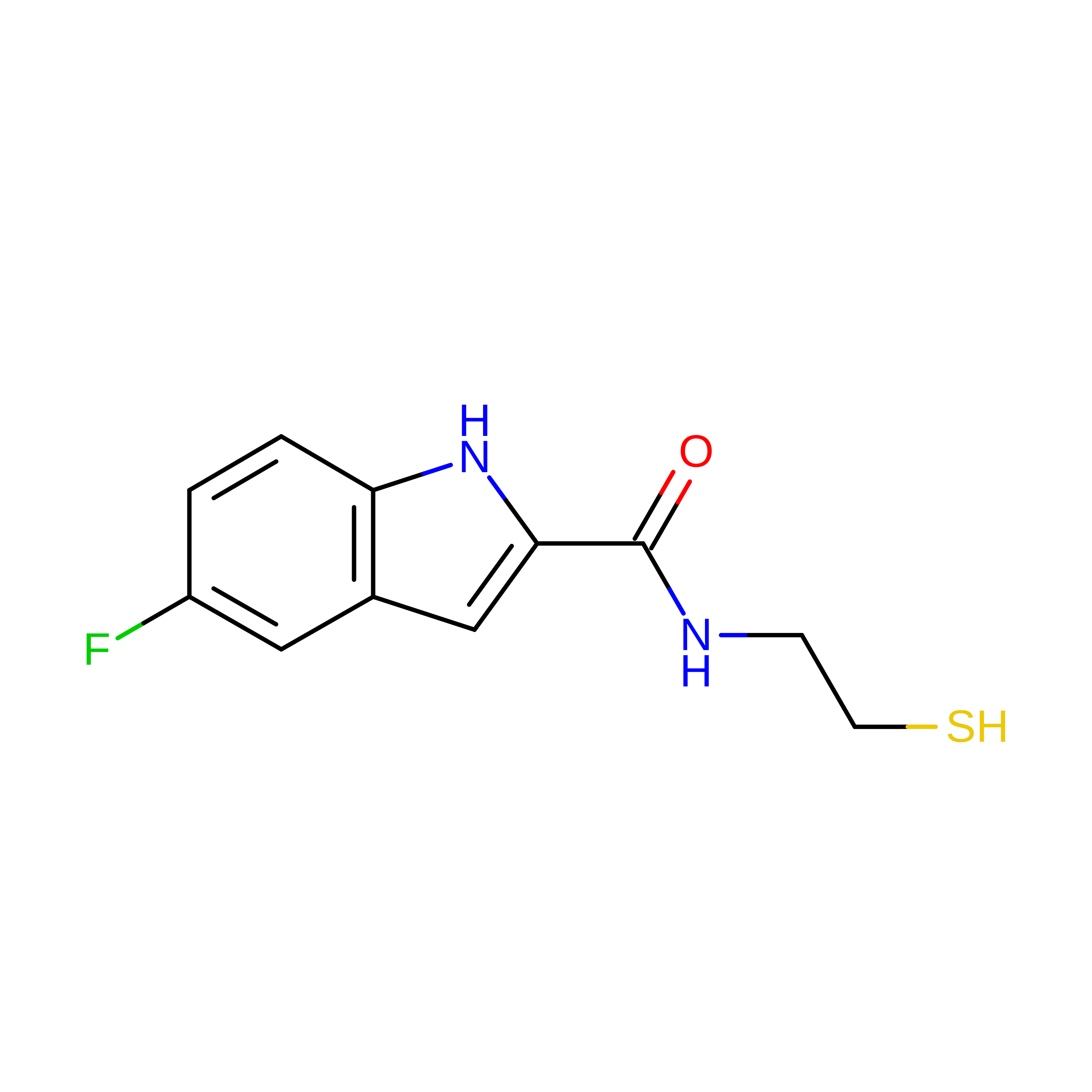
FXN

Query on FXN


Download:Ideal Coordinates CCD File
C [auth A],
D [auth B]
5-FLUORO-1H-INDOLE-2-CARBOXYLIC ACID-(2-MERCAPTO-ETHYL)-AMIDE
C11 H11 F N2 O S
JFUIHGAGFMFNRD-UHFFFAOYSA-N

Experimental Data & Validation

Experimental Data

  • Method: X-RAY DIFFRACTION
  • Resolution: 3.00 Å
  • R-Value Free:  0.273 (Depositor), 0.262 (DCC) 
  • R-Value Work:  0.221 (Depositor), 0.215 (DCC) 
  • R-Value Observed: 0.224 (Depositor) 
Space Group: P 32 2 1
Unit Cell:
Length ( Å )Angle ( ˚ )
a = 90.22α = 90
b = 90.22β = 90
c = 186.621γ = 120
Software Package:
Software NamePurpose
REFMACrefinement
MOSFLMdata reduction
AMoREphasing

Structure Validation

View Full Validation Report


Ligand Structure Quality Assessment 


Entry History 

Deposition Data

Revision History  (Full details and data files)

  • Version 1.0: 2004-08-17
    Type: Initial release
  • Version 1.1: 2008-04-29
    Changes: Version format compliance
  • Version 1.2: 2011-07-13
    Changes: Version format compliance
  • Version 1.3: 2017-08-23
    Changes: Advisory, Refinement description, Source and taxonomy
  • Version 1.4: 2021-10-27
    Changes: Advisory, Database references, Derived calculations
  • Version 1.5: 2023-08-23
    Changes: Data collection, Refinement description
  • Version 1.6: 2024-10-30
    Changes: Structure summary