3IA7 | pdb_00003ia7

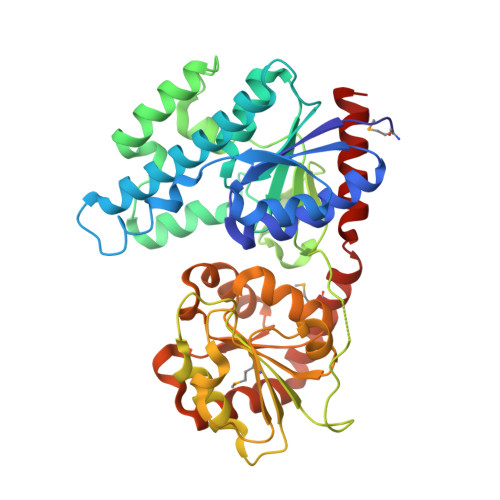
Crystal Structure of CalG4, the Calicheamicin Glycosyltransferase


Experimental Data Snapshot

  • Method: X-RAY DIFFRACTION
  • Resolution: 1.91 Å
  • R-Value Free: 
    0.301 (Depositor), 0.286 (DCC) 
  • R-Value Work: 
    0.253 (Depositor), 0.244 (DCC) 
  • R-Value Observed: 
    0.256 (Depositor) 

wwPDB Validation 3D Report Full Report

Validation slider image for 3IA7

This is version 1.4 of the entry. See complete history

Literature

Complete set of glycosyltransferase structures in the calicheamicin biosynthetic pathway reveals the origin of regiospecificity.

Chang, A.Singh, S.Helmich, K.E.Goff, R.D.Bingman, C.A.Thorson, J.S.Phillips, G.N.

(2011) Proc Natl Acad Sci U S A 108: 17649-17654

  • DOI: https://doi.org/10.1073/pnas.1108484108
  • Primary Citation Related Structures: 
    3IA7, 3IAA, 3OTG, 3OTH, 3OTI, 3RSC

  • PubMed Abstract: 

    Glycosyltransferases are useful synthetic catalysts for generating natural products with sugar moieties. Although several natural product glycosyltransferase structures have been reported, design principles of glycosyltransferase engineering for the generation of glycodiversified natural products has fallen short of its promise, partly due to a lack of understanding of the relationship between structure and function. Here, we report structures of all four calicheamicin glycosyltransferases (CalG1, CalG2, CalG3, and CalG4), whose catalytic functions are clearly regiospecific. Comparison of these four structures reveals a conserved sugar donor binding motif and the principles of acceptor binding region reshaping. Among them, CalG2 possesses a unique catalytic motif for glycosylation of hydroxylamine. Multiple glycosyltransferase structures in a single natural product biosynthetic pathway are a valuable resource for understanding regiospecific reactions and substrate selectivities and will help future glycosyltransferase engineering.


  • Organizational Affiliation
    • Department of Biochemistry, University of Wisconsin, 433 Babcock Drive, Madison, WI 53706, USA.

Macromolecule Content 

  • Total Structure Weight: 88.97 kDa 
  • Atom Count: 6,600 
  • Modeled Residue Count: 782 
  • Deposited Residue Count: 804 
  • Unique protein chains: 1

Macromolecules

Find similar proteins by:|  3D Structure
Entity ID: 1
MoleculeChains  Sequence LengthOrganismDetailsImage
CalG4
A, B
402Micromonospora echinosporaMutation(s): 0 
Gene Names: calG4Q8KNC3
UniProt
Find proteins for Q8KNC3 (Micromonospora echinospora)
Explore Q8KNC3 
Go to UniProtKB:  Q8KNC3
Entity Groups
Sequence Clusters30% Identity50% Identity70% Identity90% Identity95% Identity100% Identity
UniProt GroupQ8KNC3
Sequence Annotations
Expand
Reference Sequence

Experimental Data & Validation

Experimental Data

  • Method: X-RAY DIFFRACTION
  • Resolution: 1.91 Å
  • R-Value Free:  0.301 (Depositor), 0.286 (DCC) 
  • R-Value Work:  0.253 (Depositor), 0.244 (DCC) 
  • R-Value Observed: 0.256 (Depositor) 
Space Group: P 1 21 1
Unit Cell:
Length ( Å )Angle ( ˚ )
a = 84.749α = 90
b = 66.966β = 93.53
c = 86.616γ = 90
Software Package:
Software NamePurpose
DENZOdata reduction
SCALEPACKdata scaling
SHARPphasing
DMphasing
REFMACrefinement
PDB_EXTRACTdata extraction
HKL-2000data collection
HKL-2000data reduction

Structure Validation

View Full Validation Report


Entry History 

Deposition Data

Revision History  (Full details and data files)

  • Version 1.0: 2010-06-02
    Type: Initial release
  • Version 1.1: 2011-07-13
    Changes: Version format compliance
  • Version 1.2: 2011-11-02
    Changes: Database references
  • Version 1.3: 2017-11-01
    Changes: Refinement description
  • Version 1.4: 2024-11-27
    Changes: Data collection, Database references, Derived calculations, Structure summary