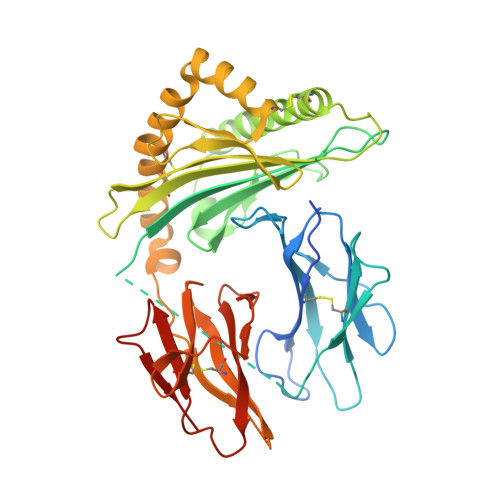
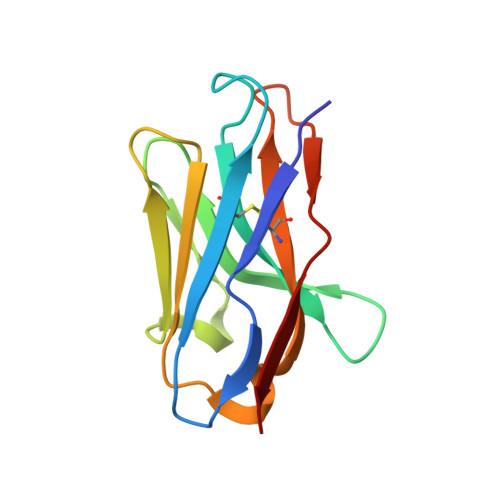
7STG | pdb_00007stg

Consequences of HLA single chain trimer mutations on peptide presentation and binding affinity


Experimental Data Snapshot

  • Method: X-RAY DIFFRACTION
  • Resolution: 2.70 Å
  • R-Value Free: 
    0.276 (Depositor), 0.278 (DCC) 
  • R-Value Work: 
    0.242 (Depositor) 
  • R-Value Observed: 
    0.244 (Depositor) 

Starting Model: experimental
View more details

wwPDB Validation 3D Report Full Report

Validation slider image for 7STG

This is version 1.3 of the entry. See complete history

Literature

Effects of HLA single chain trimer design on peptide presentation and stability.

Finton, K.A.K.Rupert, P.B.Friend, D.J.Dinca, A.Lovelace, E.S.Buerger, M.Rusnac, D.V.Foote-McNabb, U.Chour, W.Heath, J.R.Campbell, J.S.Pierce, R.H.Strong, R.K.

(2023) Front Immunol 14: 1170462-1170462

  • DOI: https://doi.org/10.3389/fimmu.2023.1170462
  • Primary Citation Related Structures: 
    7SQP, 7SR0, 7SR3, 7SR4, 7SR5, 7SRK, 7SSH, 7ST3, 7STG

  • PubMed Abstract: 

    MHC class I " single-chain trimer " molecules, coupling MHC heavy chain, β 2 -microglobulin, and a specific peptide into a single polypeptide chain, are widely used in research. To more fully understand caveats associated with this design that may affect its use for basic and translational studies, we evaluated a set of engineered single-chain trimers with combinations of stabilizing mutations across eight different classical and non-classical human class I alleles with 44 different peptides, including a novel human/murine chimeric design. While, overall, single-chain trimers accurately recapitulate native molecules, care was needed in selecting designs for studying peptides longer or shorter than 9-mers, as single-chain trimer design could affect peptide conformation. In the process, we observed that predictions of peptide binding were often discordant with experiment and that yields and stabilities varied widely with construct design. We also developed novel reagents to improve the crystallizability of these proteins and confirmed novel modes of peptide presentation.


  • Organizational Affiliation
    • Division of Basic Science, Fred Hutchinson Cancer Research Center (FHCC), Seattle, WA, United States.

Macromolecule Content 

  • Total Structure Weight: 960.96 kDa 
  • Atom Count: 56,906 
  • Modeled Residue Count: 7,554 
  • Deposited Residue Count: 8,624 
  • Unique protein chains: 2

Macromolecules

Find similar proteins by:|  3D Structure
Entity ID: 1
MoleculeChains  Sequence LengthOrganismDetailsImage
RPA-related protein RADX peptide,Beta-2-microglobulin,MHC class I antigen chimera423Homo sapiensPongo pygmaeusMutation(s): 2 
Gene Names: RADXCXorf57B2MHLA-A
UniProt & NIH Common Fund Data Resources
Find proteins for A0A678ZGP6 (Homo sapiens)
Explore A0A678ZGP6 
Go to UniProtKB:  A0A678ZGP6
Find proteins for P16213 (Pongo pygmaeus)
Explore P16213 
Go to UniProtKB:  P16213
Find proteins for Q6NSI4 (Homo sapiens)
Explore Q6NSI4 
Go to UniProtKB:  Q6NSI4
PHAROS:  Q6NSI4
GTEx:  ENSG00000147231 
Entity Groups
Sequence Clusters30% Identity50% Identity70% Identity90% Identity95% Identity100% Identity
UniProt GroupsP16213A0A678ZGP6Q6NSI4
Sequence Annotations
Expand
Reference Sequence
Find similar proteins by:|  3D Structure
Entity ID: 2
MoleculeChains  Sequence LengthOrganismDetailsImage
VHH116Lama glamaMutation(s): 0 

Experimental Data & Validation

Experimental Data

  • Method: X-RAY DIFFRACTION
  • Resolution: 2.70 Å
  • R-Value Free:  0.276 (Depositor), 0.278 (DCC) 
  • R-Value Work:  0.242 (Depositor) 
  • R-Value Observed: 0.244 (Depositor) 
Space Group: P 1
Unit Cell:
Length ( Å )Angle ( ˚ )
a = 117.593α = 102.435
b = 118.088β = 102.405
c = 273.727γ = 89.875
Software Package:
Software NamePurpose
PHENIXrefinement

Structure Validation

View Full Validation Report


Entry History 

& Funding Information

Deposition Data


Funding OrganizationLocationGrant Number
National Institutes of Health/National Cancer Institute (NIH/NCI)United States--

Revision History  (Full details and data files)

  • Version 1.0: 2022-11-23
    Type: Initial release
  • Version 1.1: 2023-05-31
    Changes: Database references
  • Version 1.2: 2023-10-25
    Changes: Data collection, Refinement description
  • Version 1.3: 2024-11-13
    Changes: Structure summary