Download Mendeley
Dimer asymmetry in signaling of blue light sensor histidine kinases.
Arinkin, V., Stadler, A.M., Meier, S.S.M., Jaeger, K.E., Moglich, A., Krauss, U., Batra-Safferling, R.(2026) Sci Adv 12: eaed8943-eaed8943
- PubMed: 42384803 Search on PubMedSearch on PubMed Central
- DOI: https://doi.org/10.1126/sciadv.aed8943
- Primary Citation Related Structures:
8A3U, 8A52, 8A6X, 8A7F, 8A7H - PubMed Abstract:
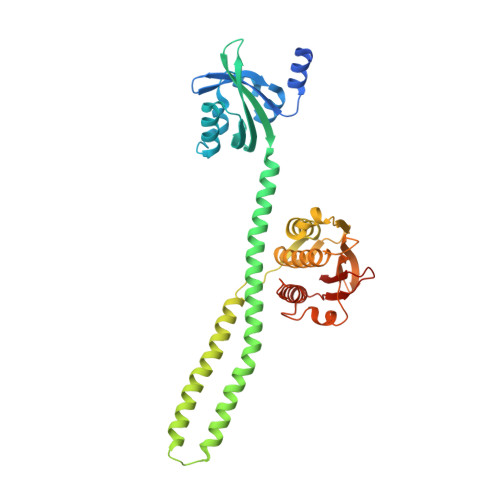
Photoreceptor sensory histidine kinases (SHKs) couple light absorption to conformational changes regulating two-component signaling. Despite their importance and widespread use in optogenetics, the underlying structural signaling mechanisms remain poorly understood. Here, we engineered dimeric SHKs based on Pseudomonas putida short light-oxygen-voltage (LOV) proteins, determined their crystal structures, and investigated their signaling mechanisms. Regardless of illumination, the structures adopted a light-state like LOV-LOV dimer with symmetric/straight kinase modules. In contrast, small-angle x-ray scattering together with functional assays revealed pronounced light-dependent rearrangements in solution and allowed the assignment of the kinase-ON dark state to an asymmetric/kinked conformation, whereas the light state adopts a symmetric/straight structure. Comparative analyses of natural and engineered SHKs identified conserved motifs linking light-induced LOV domain rotation to kinase activity. The findings highlight the central role of dimer asymmetry and flexibility in SHK signaling, thereby not least informing the engineering of new light-responsive signaling systems.
- Institut für Biologische Informationsprozesse (IBI), Strukturbiochemie (IBI-7), Forschungszentrum Jülich, 52425 Jülich, Germany.
Organizational Affiliation: